
In 2024, NORINCO—China’s state-owned defense conglomerate—unveiled a coaxial rotor drone dubbed the Black Bee. The design bears a striking resemblance to patented coaxial UAVs developed by Ascent AeroSystems, a U.S. firm now owned by Robinson Helicopter Company.
There is no record of any joint venture, licensing deal, or technology transfer between Ascent and NORINCO. But the Black Bee’s silhouette, rotor configuration, and centerline architecture align so closely with Ascent’s proprietary platform that accusations of IP theft followed swiftly.
“Looks like the China North Industries Group Corporation has taken a liking to Ascent AeroSystems’ coaxial design,” said David Smith, President of Robinson Helicopter.
The replication goes beyond aesthetics; internal structure, flight dynamics, and even dimensions appear reverse-engineered to mimic the original—without compensation or consent.
“No license. No permission. Just copy it and start making your own. Maybe the PLA will be a customer. Nice.”
The drone has since appeared in PLA-adjacent defense demonstrations, showcasing its tactical role under China’s civil-military fusion strategy. That strategy blurs the line between commercial innovation and military adoption, creating an exportable product indistinguishable from one developed under a U.S. patent.
Reports from open-source intelligence investigators and Indian outlet Mint reveal that Chinese drone engines have reached Russia via falsified customs forms listing the goods as “industrial refrigeration units.” These shipments, which evade U.S. and EU sanctions, include powertrains and propulsion units compatible with Iranian-designed Shahed UAVs now mass-produced in Russia’s Alabuga facility.
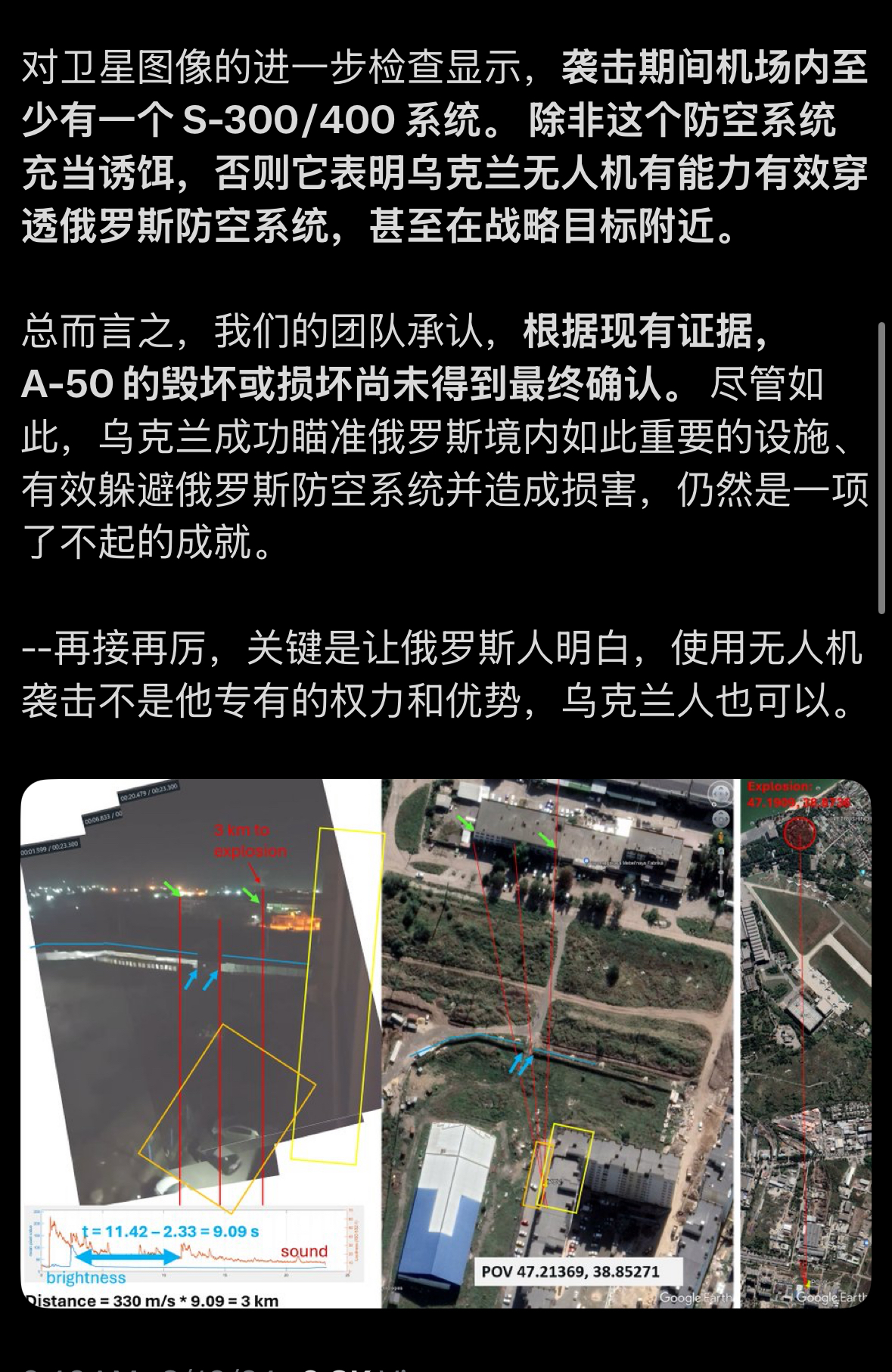
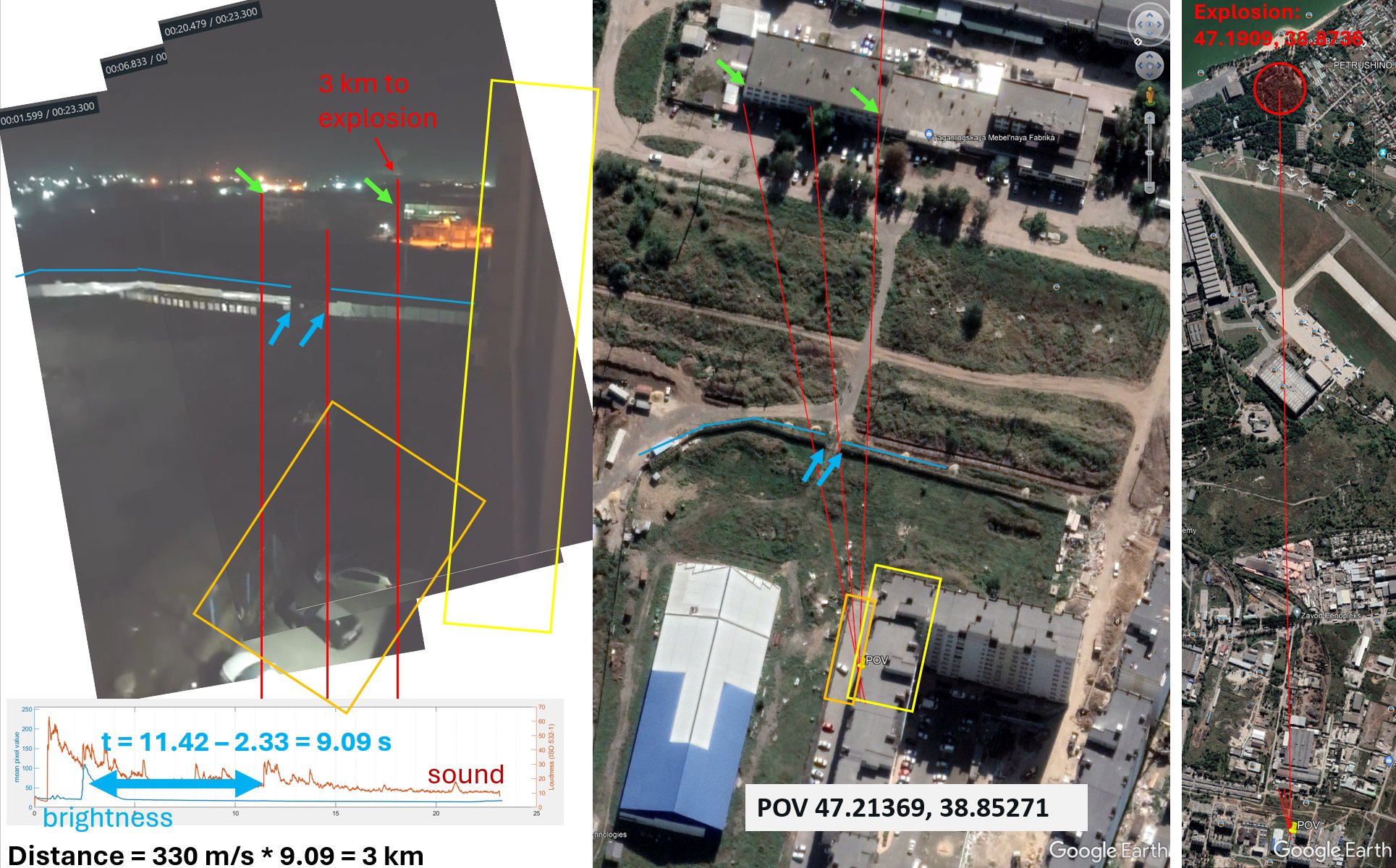
Open-source intelligence analysts reconstructed this Shahed drone strike using video footage, satellite imagery, and acoustic timing to geolocate the explosion site near Taganrog, Russia. The estimated 3 km distance from the camera position was calculated by measuring the time between the flash and the sound of the blast, confirming precision delivery despite active air defenses.
OSINT analysts have corroborated the delivery routes and impact zones using geolocated video footage, acoustic delay analysis, and satellite imagery to pinpoint the supply chain’s effectiveness and its real-time battlefield consequences. One such analysis placed the moment of explosion exactly 3 kilometers from a confirmed point-of-view, cross-verified with Google Earth coordinates and synchronized sound-brightness curves—effectively tracing the strike back to suspected imported components.
The U.K.-based open-source group Conflict Armament Research and Ukrainian military intelligence have corroborated these findings, identifying Chinese engines recovered from Russian drones launched into Ukraine. While China denies military exports to Russia, the customs trail—and visible manufacturing marks—tell another story.
While kinetic warfare plays out over battlefields, China is also exporting a form of psychological infrastructure: data-driven behavioral modeling built into entertainment platforms.
NetEase, one of China’s largest tech firms, is the publisher of Marvel Rivals, a multiplayer shooter currently in closed testing across the West. Beneath its colorful animation and fast-paced gameplay lies a sophisticated framework—Engagement Optimized Matchmaking (EOMM)—a system designed to manipulate emotional and psychological patterns of users in real time.
NetEase researchers published their EOMM methodology in a 2017 IEEE paper, describing a matchmaking algorithm that uses telemetry data, historical performance, and predicted frustration thresholds to deliberately orchestrate winning and losing streaks—maximizing time played and emotional investment.
While EOMM is framed as a commercial tool, it produces massive volumes of Western behavioral data, legally accessible to Chinese intelligence agencies under China’s 2017 National Intelligence Law. That law requires all Chinese companies to “support, assist, and cooperate with state intelligence work.” The U.S. Department of Homeland Security’s 2024 Homeland Threat Assessment warns explicitly of “nation-state efforts to malignly influence U.S. audiences” via digital platforms. [DHS, 2024 Homeland Threat Assessment]
A 2023 Center for a New American Security (CNAS) commentary further raised concerns that Chinese state-tied games may serve as intelligence platforms, warning that behavioral data harvested through gamified systems could support AI training, target profiling, or influence modeling. These fears were echoed by Israeli cybersecurity analysts cited in a Times of Israel report, which argued that such systems threaten fairness, national security, and user autonomy.
In parallel, Chinese regulators have imposed strict domestic limits on gameplay for children—including curfews, anti-addiction warnings, and spending caps—directly targeting the psychological effects of these systems on their own population. In 2021, both Tencent and NetEase were summoned by Beijing authorities to “overhaul” their gaming platforms. They were instructed to curb in-game purchases, tone down addictive mechanics, and reduce perceived “worship of money and effeminacy.” [Forbes, 2021; Global Times, 2021]
But those restrictions don’t apply to exported platforms. Systems like EOMM, stripped of domestic oversight, continue to operate in Western markets—modeling, testing, and harvesting behavioral insights from foreign users with far fewer limitations. The contradiction is stark: Chinese children are shielded from psychological overexposure, while Western users are subjected to highly adaptive, emotionally manipulative mechanics designed to maximize engagement.
NetEase also operates one of China’s largest media portals, curating content across its network and social platforms. In May 2024, The Zero Lux confirmed that NetEase’s verified news account on Chinese social media reposted a video originally shared by Russia’s Sputnik network. The video showcased Russian drone operations, accompanied by the translated caption: “Victory will be ours! Russia will definitely win!”—a direct amplification of wartime propaganda aimed at Chinese audiences.
In a now-archived post from May 2024, NetEase’s verified news channel amplified a Sputnik report about a Chinese drone company establishing manufacturing lines in southern Russia. The post featured an image of a large agricultural-style drone and was captioned: “Victory will be ours! Russia will definitely win!” One Chinese user, reacting critically, wrote: “Russia drags the CCP down while pretending to be close allies… when the war turns, they’ll throw China under the bus.” This layered response—NetEase amplifying Russian propaganda while users openly question the alliance—highlights how Chinese media firms can simultaneously serve as propaganda relays and domestic narrative battlegrounds.
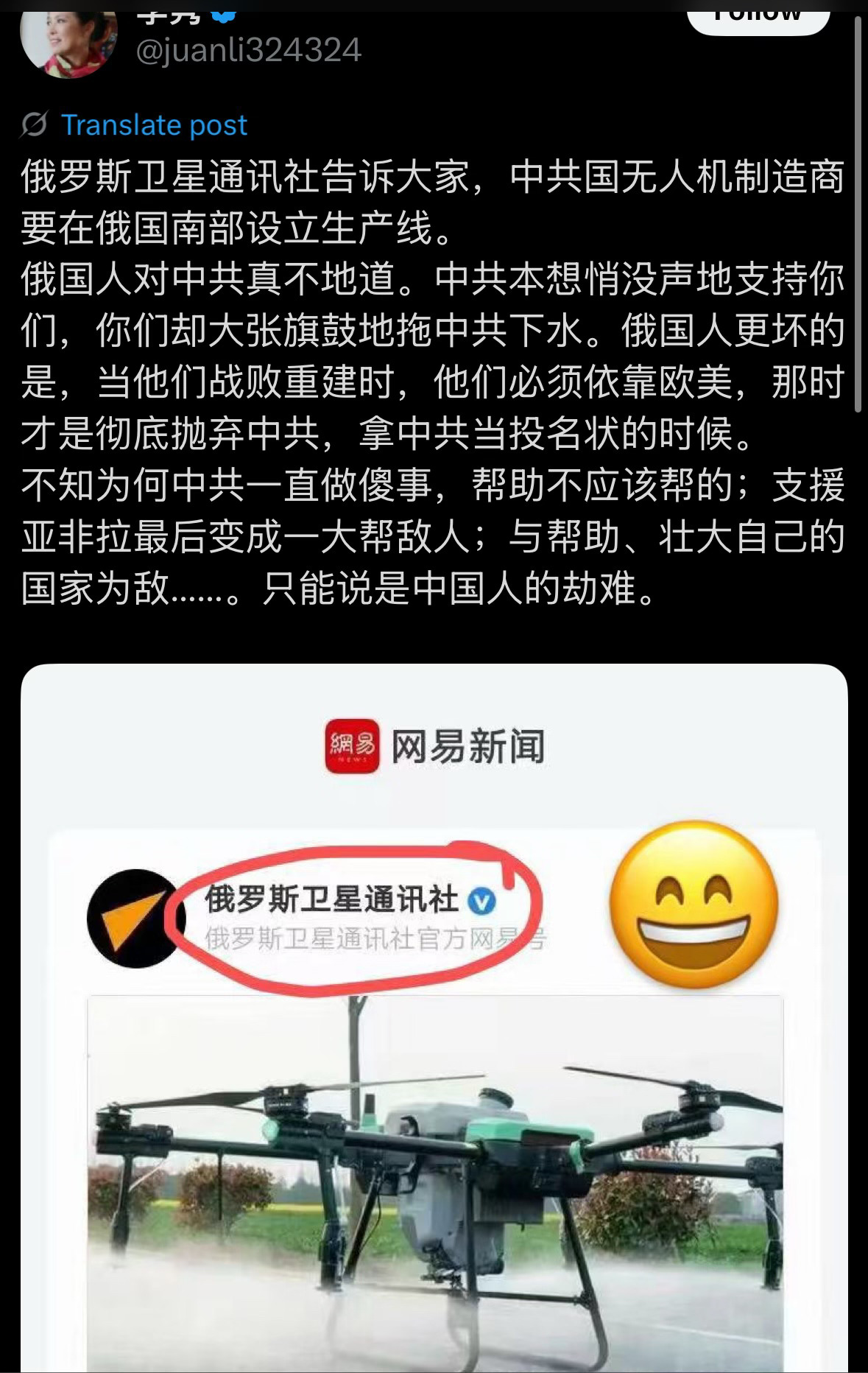
This post was preserved, translated from Simplified Chinese, and cross-referenced with open-source video analysis to confirm the footage matched publicly available broadcasts from Russia. While NetEase markets itself as an entertainment brand in the West, its domestic media posture aligns more closely with state messaging. The company maintains a dual identity—video game publisher abroad, national amplifier at home.
Each of these examples can be viewed on its own. A copied drone design. Sanctioned components moving through global supply chains. A matchmaking system designed to keep players engaged. A media platform amplifying Russian messaging.
Taken together, though, they point to a broader pattern.
The drone closely resembles a patented U.S. design. Chinese-made engines have been recovered from Russian drones after traveling through supply chains disguised as commercial goods. Gaming platforms collect enormous amounts of behavioral data while using algorithms designed to predict how people will respond. At the same time, major Chinese technology companies operate media platforms that promote narratives aligned with Beijing's interests and, in some cases, Russia's.
None of these examples proves a single coordinated program on its own. But together they show how manufacturing, logistics, technology, and information can reinforce one another in ways that deserve closer attention.
Modern competition between nations isn't limited to missiles or military bases. It increasingly involves supply chains, software, media, and the ability to understand and influence behavior at scale.
A drone designed in the United States has a strikingly similar counterpart produced by a Chinese state-owned defense company. Chinese-made engines have appeared in Russian drones despite international sanctions. A commercial gaming platform uses sophisticated engagement models while operating under Chinese laws that require companies to assist state intelligence work. A major technology company also operates media platforms that have amplified Russian wartime messaging.
Viewed separately, each case raises its own questions. Viewed together, they suggest a broader trend that extends well beyond traditional espionage.
That's why OSINT matters.
Patents, shipping records, customs data, academic research, satellite imagery, battlefield recoveries, and public posts rarely tell the full story by themselves. When they're verified and connected, they can reveal patterns that would otherwise go unnoticed.
At The Zero Lux, that's the goal. We don't begin with a conclusion. We begin with evidence and follow it wherever it leads.


