
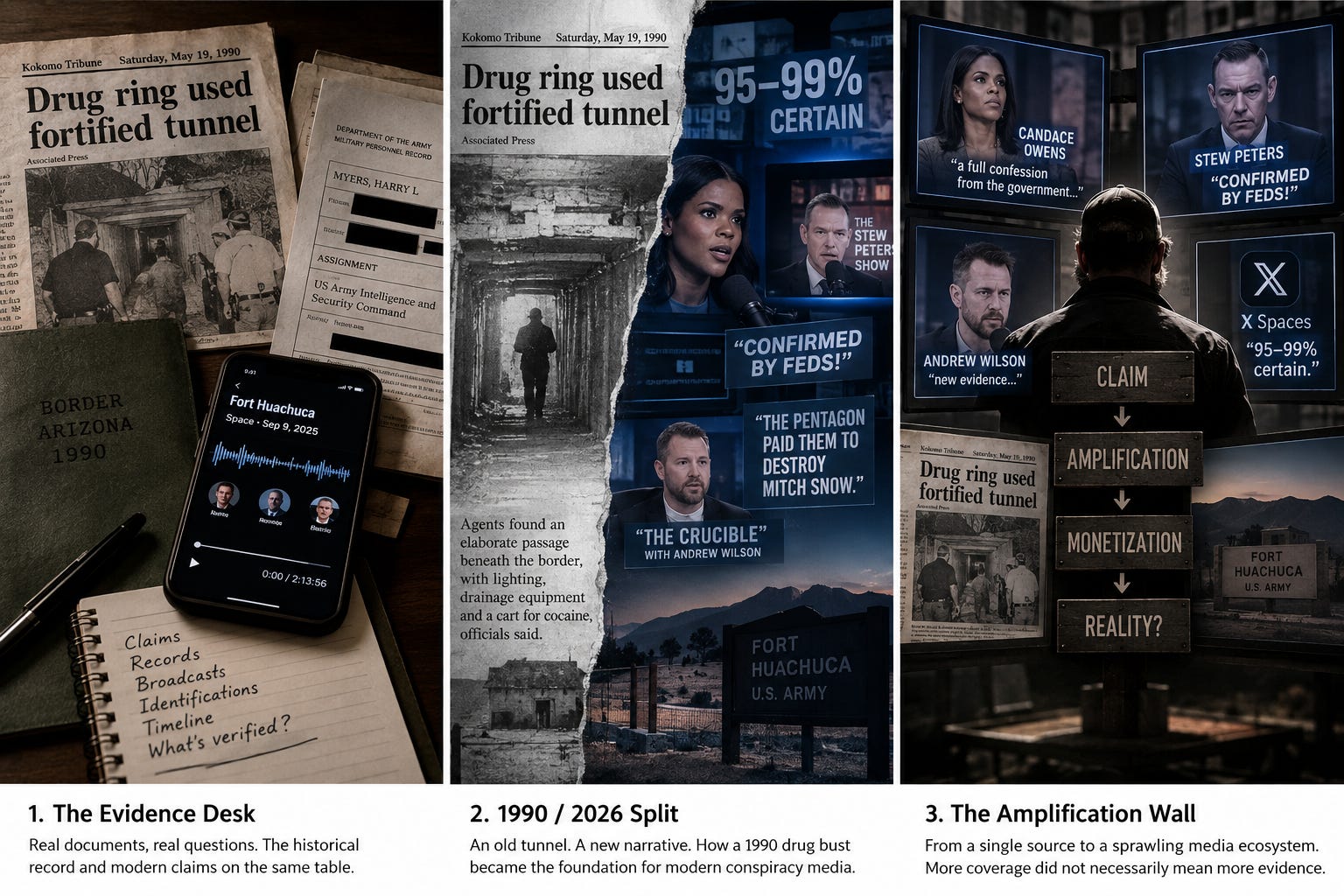
An old cartel tunnel, disputed identifications and months of programming sold as revelations. The records behind Mitch Snow tell a different story from the certainty built around him.
In April 2025, Mitch Snow was asked to introduce himself on a livestream. He talked about growing up in Washington, joining the Army and working with Border Patrol. Then came the accomplishment that would help carry him onto a much larger stage. “I was responsible for uh discovering the first tunnel network by the cartel stuff,” he said. It was, he added, “the largest drug bust in history in 1990.”

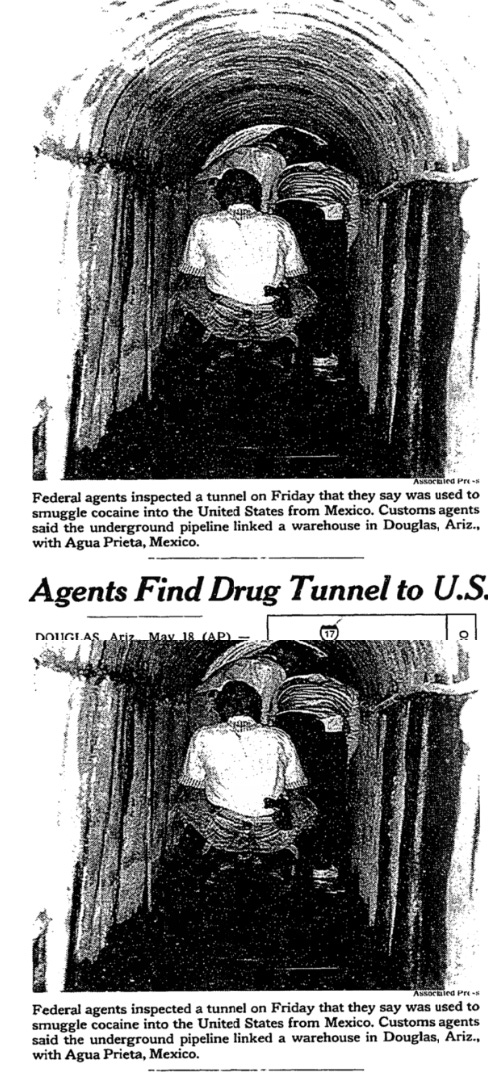
Seven months later, Candace Owens introduced a television report about that tunnel. “I’m going to pause here to let you see an old news clip regarding this explosive discovery that Harry made,” she said, using Snow’s former first name. The archive showed a reinforced passage beneath the Arizona-Mexico border. Customs agents had received a tip; a cocaine shipment had been seized. Nothing in the excerpt identified Harry Myers as its discoverer. The broadcast documented an event. Owens supplied its hero.
The claim was being put to a much larger use. Before the first minute of her December 9 episode had ended, Owens announced: “I just cannot see how this would lead to anything other than a full confession from the government about the military’s involvement in his assassination.” She was talking about Charlie Kirk. The witness whose account would support that declaration was Snow.
His story concerned two encounters at Fort Huachuca, Arizona, in the days immediately before Kirk was killed. Snow would say he was 95 to 99 percent certain that a woman he remembered from a hotel lobby was Erika Kirk, Charlie’s wife, and that a man he remembered leaving a meeting was Brian Harpole, whose company provided Kirk’s security. He attached those names later, after seeing photographs and public appearances. Owens acknowledged that she could not confirm the identifications. Yet she presented them within coverage predicting a government confession, and later described Snow as a hero and promised to raise money for him.
A review of the interviews, historical reporting, military-record images and subsequent coverage exposes the distance between those assurances and the evidence supporting them. Snow exaggerated the scale of the drug bust he invoked as a credential. His account of personally locating the tunnel has not been established by the documents collected here. His recollections of strangers became confident identifications; confirmation that he had encountered military police was then used to defend much more than his presence on the base. Hosts who embraced him went on to portray challenges to his credibility as evidence of a campaign to suppress the truth.
By September 2026, the claims were still producing programs. Stew Peters’s network advertised one as “MITCH SNOW FORT HUACHUCA STORY CONFIRMED BY FEDS!” Another was called “THE PENTAGON PAID THEM TO DESTROY MITCH SNOW.” The public listings promised revelations about the people supposedly trying to discredit him. A paid community was offered alongside the coverage.
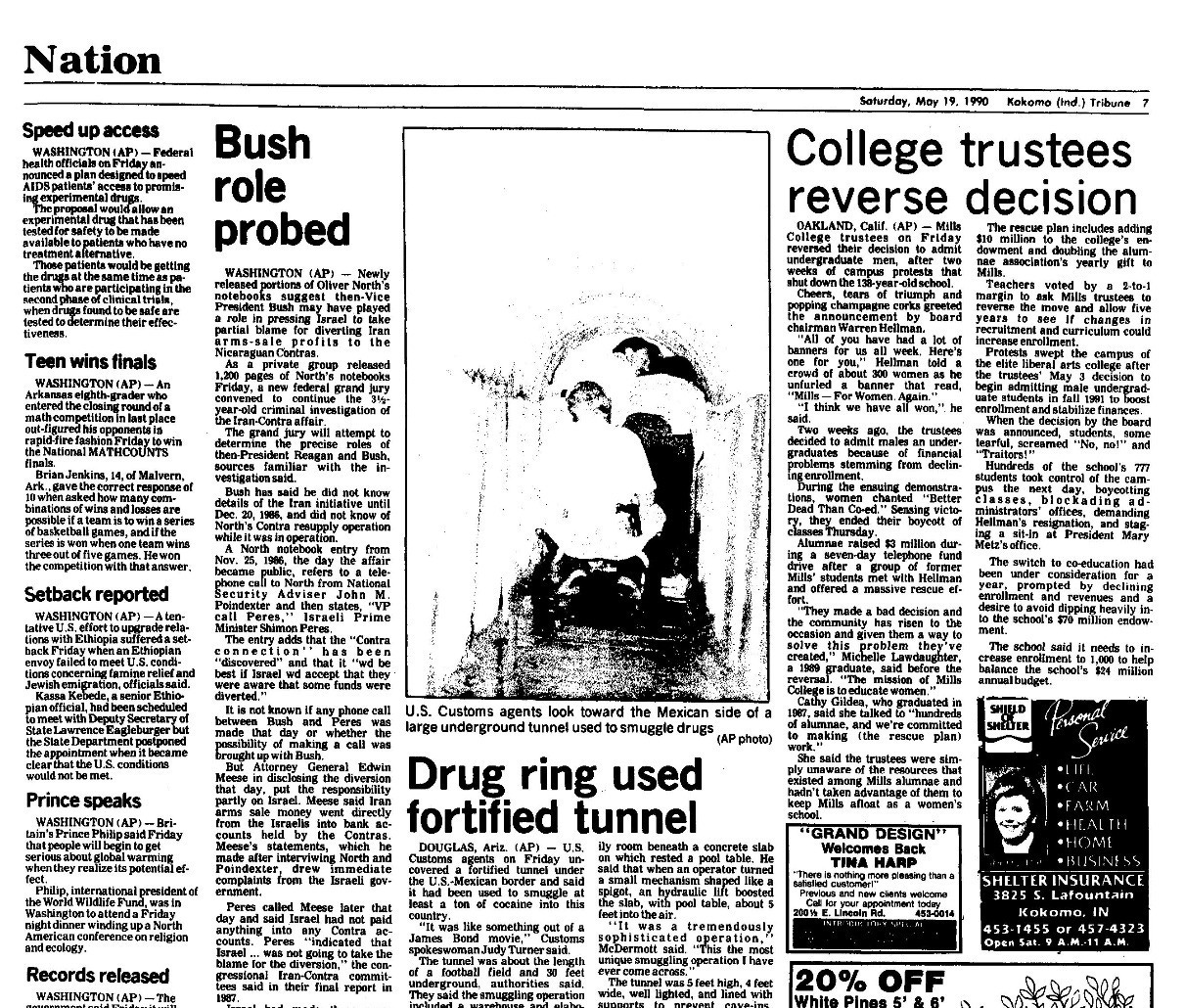
The tunnel at the beginning of this story was an extraordinary piece of engineering. On the Mexican side, a section of floor beneath a pool table could be lifted hydraulically to reveal the entrance. A reinforced passage ran under the border to a warehouse in Douglas. The Associated Press account preserved in a May 19, 1990 newspaper described electric lighting, drainage equipment and a cart that could carry cocaine through the tunnel. Thomas McDermott, the Customs official overseeing the Arizona operation, compared it to a James Bond movie.
Its construction was concealed behind ordinary work. Witnesses later described a warehouse purportedly intended for washing trucks and drains that did not drain. An appellate opinion in the prosecution of architect Felipe de Jesús Corona-Verbera recounts how a tip led Customs agents to watch the warehouse. They followed a flatbed truck to a complex at Queen Creek. A May 11 search there uncovered 2,037 pounds of cocaine. Six days later, agents searched the Douglas warehouse, found a grate over a disguised concrete door and broke through with a jackhammer. An apparent water spigot at the Mexican residence operated the hidden pool-table entrance. Trial testimony attributed the tunnel’s construction to Corona-Verbera at Joaquín Guzmán’s direction.
The old broadcasts tell the story as investigators explained it at the time. One emphasizes surveillance of the cocaine shipment. Another reports that Customs had received tips but “couldn’t believe it until geologists confirmed its existence.” It describes testing the ground for an underground void. A later Arizona television retrospective identifies Grant Murray as the lead agent on the case.
Contemporary Los Angeles Times reporting credited military geologists and described equipment and operators coming from the Colorado School of Mines.
A 2005 technical paper by Army Engineer Research and Development Center researchers and an Alion coauthor states: “The Douglas drug tunnel was discovered by HUMINT in May 1990.” HUMINT is shorthand for human intelligence. The authors describe Douglas as a site used to evaluate surface geophysical techniques, distinguishing searches for unknown tunnels from experiments at already discovered ones.
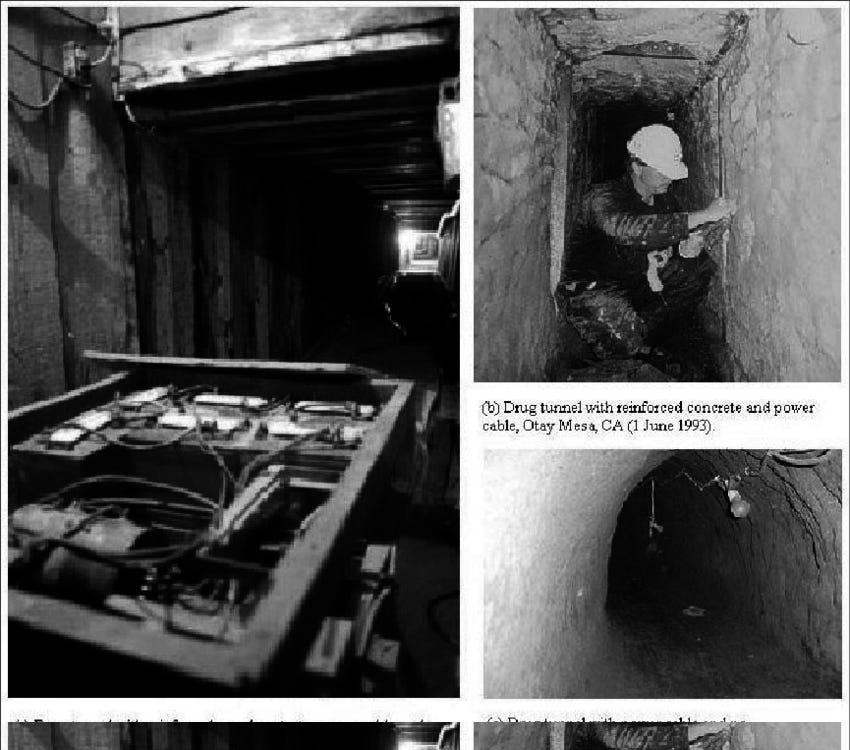
The accounts differ in the emphasis they give intelligence and geophysical assistance. The technical paper’s HUMINT classification does not exclude a contribution from sensors, and the court opinion is not a roster of everyone who helped. What these sources describe is a Customs-led investigation with intelligence leads and specialized assistance. None of them identifies Snow or Myers as the person who supplied the breakthrough he later claimed.
The size of the seizure is less ambiguous. The Justice Department’s historical table lists a 21,000-kilogram cocaine seizure in California in 1989, more than twenty times the weight seized at Queen Creek. Snow’s description of the Douglas operation as the largest drug bust in history does not survive that comparison. A famous tunnel was not the same thing as a record drug seizure.
The December interviews supplied the mechanics of Snow’s discovery claim. In six days, he said, he had planted sensors, interpreted their readings and bypassed the chain of command to pinpoint the tunnel. On Owens’s December 18 program, he described an assignment from the 10th Mountain Division, approximately eighty sensors and signals others had mistaken for glitches. A Border Patrol counterpart had mocked the Army equipment until they discussed what it was recording. “Between the two of us, the light bulb went on,” Snow said.
He described triangulating the signals within minutes. He said he did not take part in the raid. Instead, the information he passed along supplied “the probable cause they needed to be able to go get a warrant.” His claim concerns the evidence that advanced a specific investigation, not simply whether he had been a soldier near the border.
His service record provides an actual chronology. A personnel release under the name Harry Lawrence Myers records active service from January 11, 1989, to November 15, 1996. The attached assignment page lists him as a 96R10 ground-surveillance systems operator with B Company, 110th Military Intelligence Battalion at Fort Drum, effective May 15, 1989. The next listed transfer is in April 1991. Later entries show an 18D student assignment, Special Forces engineer and language training, and engineer duties at Fort Lewis. The awards summary lists the Special Forces Tab and an Army Achievement Medal with two oak-leaf clusters.

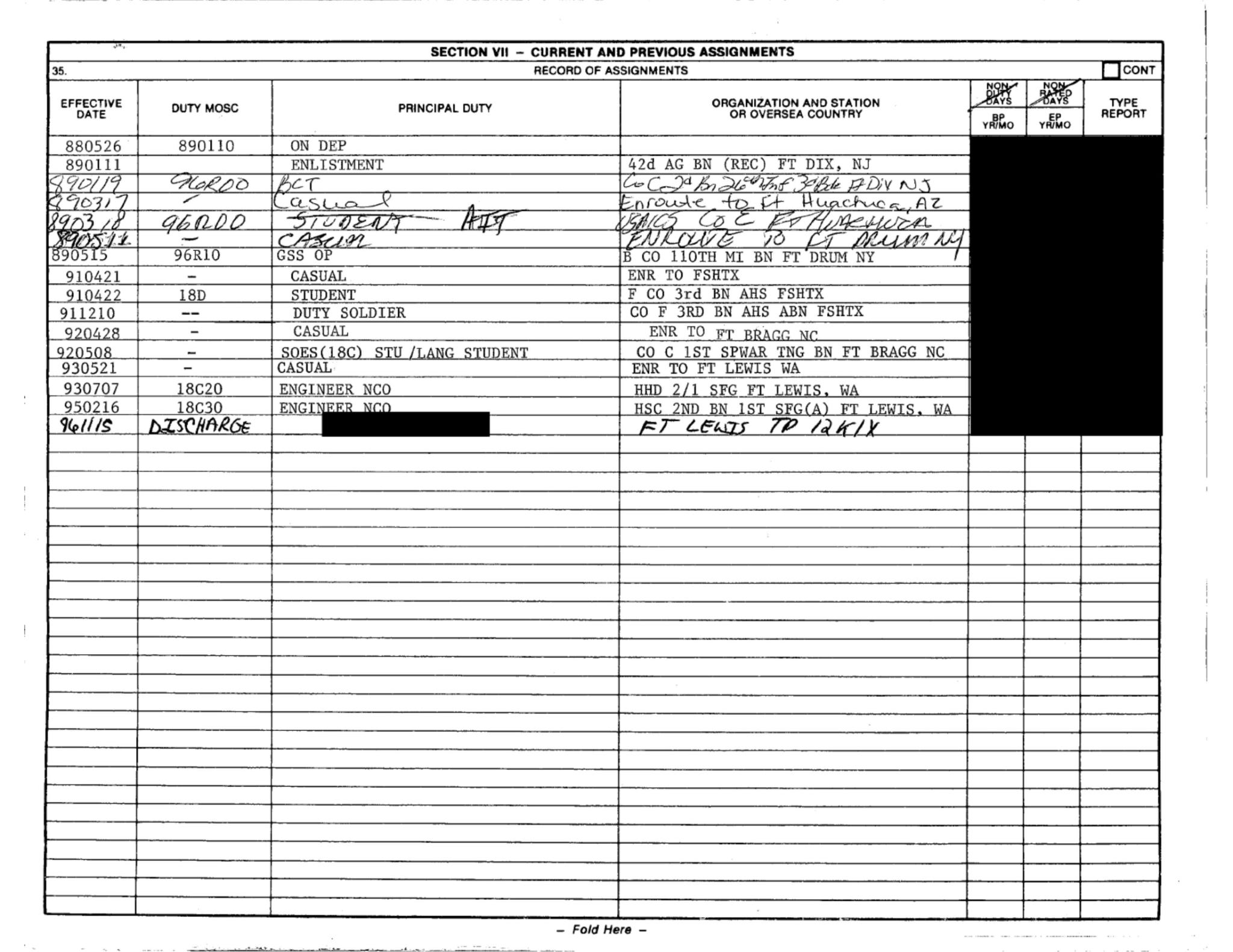
The assignment-page attachment in the supplied military-record packet. Its May 1989 entry records a ground-surveillance assignment at Fort Drum. Original redactions are retained. This is an assignment history, not a Douglas mission report.
The record establishes his surveillance duties and later Special Forces career. It does not establish a role in the Douglas investigation, nor is the assignment page a record of every temporary duty. Snow himself identified a document that he said supported his contribution. In the statement Owens read, he said: “I have the writeups for those awards mentioning me and my critical role in this mission success.”
Gary Melton of Paramount Tactical said Snow had an Army Achievement Medal write-up for Snow’s border support. “There’s no mention in there about assisting with a drug bust,” he told his audience. The award narrative has not been obtained for this article, so Melton’s description cannot settle its contents. Nor can the archival footage Owens played establish the personal role Snow said his award documented.
The same gap extends to the most dramatic part of Snow’s tunnel account. He said photographs found on the Mexican side showed a commander and other officials posing with El Chapo and the architect. His clearance information supposedly reached the cartels. In Naco, a man approached him with personal details about his family and childhood. A Border Patrol agent recognized the danger, and Snow was returned to base. Owens presented that sequence as the beginning of decades of retaliation. The archival report she played did not establish the alleged photographs or the compromised commander.
Snow said he was debriefed by Army criminal investigators and a prosecutor from Tucson. Protection was promised, restrictions were placed on his work and an NDA would silence him until May 2025. His April 28 livestream, however, already contained his public claim to have discovered the cartel tunnel. That disclosure preceded the endpoint he later gave for an agreement intended, in his account, to prevent him from mentioning the ordeal. Neither appearance explains the timing.
There was another qualification in the account Owens read: “The witness protection entrance never happened. The ball got dropped. I never got contacted for it.” Snow described protection promised and never delivered. In the later interview, Owens summarized the surrounding story more cleanly: “You’ve been on the run. You’ve had to change your name.” She described a government that had destroyed his life and asked whether that was fair. “Yeah, it is,” he replied.
Aaron Massie, a former friend interviewed on Melton’s Dangerous Liberty program, recalled a different explanation. Snow had told her he adopted the name because he “thought it was a cool last name,” she said, and had also spoken about his father. Melton placed the change around his 2010 marriage to a woman whose surname was Snow. Their account is not a substitute for a name-change order, but it challenges the explanation Owens gave her audience. Snow’s own statement described promised protection that never materialized, not a new identity issued through admission to witness protection.
Snow’s public grievances predated the Kirk controversy. The April livestream centered on his family and court disputes, and the hosts promised a recording of a judge’s voice. When a host again called it the judge’s recording, Snow immediately corrected him. An investigator working with his defense was asking the questions. “It’s not the judge, but it might as well be that they knew about it,” Snow said. His correction identified the speaker; the accompanying explanation asserted the judge’s knowledge. The audience was hearing an investigator’s questions, not the judge’s voice promised earlier in the show.
People who had known Snow disputed his account of those conflicts. In an excerpt played on Melton’s program, Snow described women as grifters who arranged to have men jailed, then entered their homes and took their property. His former partner answered that she had lived with him for eighteen months and recovered her belongings under a protection order. Massie disputed a shared-caregiver connection Snow offered to explain how people had become involved. These were specific disagreements over events and relationships, not merely anonymous objections to his politics. Snow alleged that the people around him and court officials were part of a broader effort to ruin him; the interviewees denied that account.
The tunnel story eventually became his explanation for returning to Fort Huachuca. He told Owens he went there for original records and to learn why the FBI had not been updated about his status. In an interview with A Better Life with Teresa, he called himself a “national security protected asset.” His purported role in 1990 thus served both as a credential and as the reason he happened to be at the base in September 2025.
Owens’s first broadcast placed him at the Candlewood Suites on the evening of September 8, checking in at about 5:37. He noticed a man, then a woman who joined him. They left in a green pickup. The woman was someone “at the time he did not recognize,” Owens said. The next morning, according to the account, Snow entered a temporary headquarters, saw people leaving a meeting and was questioned by military personnel. The man he later associated with Harpole was not recognized by name during that encounter either.
The identifications developed through later images and coverage. Snow described seeing Harpole’s face and mannerisms in an interview and feeling recognition in his gut. “I just have a gift for recognizing people,” he said. He listed physical characteristics, gestures and gait. He also allowed that “maybe it’s not him” and raised the possibility of a double. When Owens asked him for a percentage, he answered 95, then 95 to 99.
For Erika, an older photograph showing a ponytail helped him connect a name to the woman in the lobby. “Those are really rare eyes,” he said. He put his confidence at 95 to 99 percent and added: “I can’t imagine somebody else.” The number was his estimate of confidence in a memory, formed into an identification after exposure to photographs. It was not an independently verified probability that she had been there.
Owens expressly identified the limit of her checking. “I obviously can’t confirm that you saw who you say you saw,” she told him. She said she could verify his movements and had spoken with people about the location. She considered the possibility that Erika had not been there or had visited for an unrelated reason. Then she explained why she had decided to proceed: Snow had suffered, he was a hero, and refusing him a platform would feel like turning her back on him.
“I genuinely believe this is God’s platform,” Owens said. “I am a conduit.” She described praying before the email that brought Snow to her attention. Near the end, she promised to help raise money for him. He had “potentially” stumbled upon something corrupt, she said, then corrected herself to “did definitively.” The missing verification of the identities remained missing. Her commitment to the witness had become definite.
For Harpole, the allegation concerned both his character and his livelihood. His April 30, 2026 complaint identifies him as the founder and head of Integrity Security Solutions and describes the firm’s work protecting Kirk. “Brian Harpole has never been to Fort Huachuca. Not ever,” the complaint states. It says travel records place him in Dallas on September 9 and alleges that the coverage cost him major clients and subjected him to daily accusations that he murdered Kirk. Harpole’s complaint makes those claims; it is not a court finding that establishes them. Snow challenged the lawsuit in a motion to dismiss.
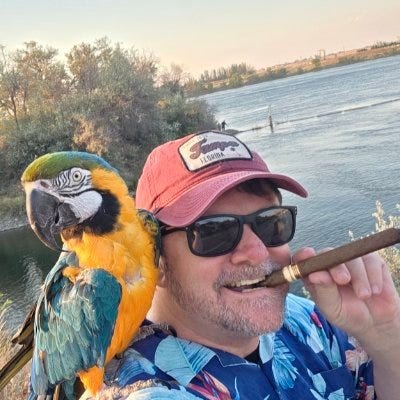
When Snow appeared with Stew Peters in January, he described his account as a tip. “If I’m wrong, okay,” he said. “It was meant to be a tip.” He acknowledged fallibility while insisting that he stood by what he had said. Peters had already framed the criticism as a campaign to destroy a witness who saw something he was not supposed to see. “I think that you did see what you say that you saw,” he told Snow.
The endorsement preceded the examination. Peters described an army of influencers, attacked people interviewing Snow’s relatives and former partners, and complained that they would talk about Snow rather than talk to him. Snow answered that people with something to hide preemptively discredit someone who has dirt on them. In that account, the emergence of criticism did not require reconsidering the testimony. It explained why the testimony was dangerous.
The claim of vetting acquired another name when Snow spoke about Joe Kent. He told Teresa they had talked for about fifteen minutes around December 10 and that he had supplied records afterward. It was their only conversation, he said. Kent could investigate the material and had access to his history. The interview provides Snow’s description of the vetting; it does not provide Kent’s account of what he checked or a statement from Kent establishing either identification.
Baron Coleman had offered a similar defense as early as December 30. Snow’s adult son told Melton that authorities had contacted him from the base, and Coleman seized on that as a rebuke to critics. “So he does tell the truth, Morgan,” he said. The son’s account supported an encounter with authorities. It did not put Harpole in the meeting or Erika in the hotel. Those were the disputed claims that made Snow’s presence consequential.
Coleman also offered an explanation for people who wanted to put the story aside. “You’ve been activated,” he said. He described orders to get it out of the way. “That’s just a fact.” Then he added: “I’ll blanket it with saying it’s my opinion just for legal purposes.” The accusation survived its reclassification.
By September, this was not simply a December interview that had been left online. A Peters listing announced federal confirmation of the Fort Huachuca story. The network’s longer program, The Influencer Army That Tried to Erase Fort Huachuca, described Melton’s acknowledgment of Snow’s presence as a belated admission. Its podcast listing ran four hours and thirty-two minutes and included several subjects; a separate segment was titled “GARY MELTON BREAKS: Mitch Snow Was 100% On Huachuca.”
Melton’s archived December program had already accepted that Snow was at the base while disputing the identifications and larger account. Presenting that position as a new collapse of the case against Snow recast an old, limited acknowledgment as vindication. The alleged meeting participants had not become independently identified because a critic agreed that military police encountered Snow.
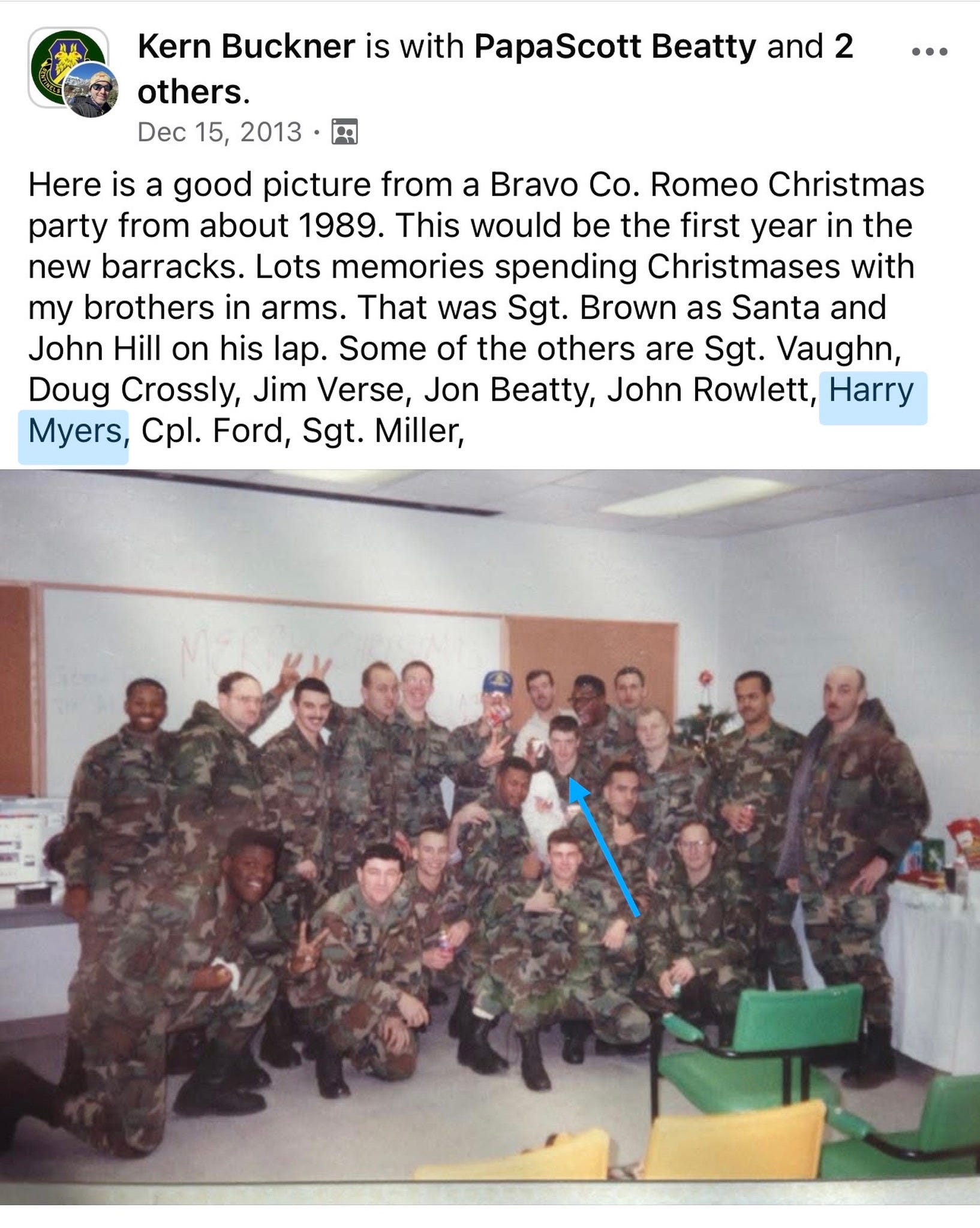
It was not confined to the hosts. The account Project Constitution, which published material defending Snow, mentioned Coleman’s research and also cited research done by a user that goes by mia_stretch whose real name is Sabrina Oushana Behney Stretch. Another account, Nihilox, boosted material produced by members of this network. The chronology of the preserved Zero Lux is based on these publicly cited research sources and references over several months.


Elizabeth Lane, a public critic of Snow, became one of the subjects of that coverage. Amateur researcher, Nihilox claimed was already researching her before a September 9 Space, a live audio discussion on X. Honest Ash, another account defending Snow, amplified that work. A public exchange between Lane and Peters preceded the confrontation; Peters attacked her name and hair. In the Space, Lane disputed Snow’s credibility and his account of their communications. When Peters shifted attention to Lane’s appearance, a speaker objected that she was not the key witness whose account was reaching a vast audience.
The argument spread beyond the room. Ashley Walker, who goes by realhonestash on X, posted excerpts defending Snow; Project Constitution sided with Peters; Snow continued attacking Lane and the people associated with her. The material then circulating included a Peters segment titled The Pentagon Paid Them to Destroy Mitch Snow. Its description alleged a Defense Department operation using paid influencers against dissidents. That was the network’s claim about its opponents. The listing did not identify contracts or payments establishing that the people challenging Snow had been hired by the Pentagon.



Screenshots from a private group chat featuring Lane became publicly available. The recorded timeline shows that Nihilox (Travis) posted one on September 12 at 00:35:42 UTC and another at 04:08:03. Snow then republished the material from the second screenshot twenty-nine minutes and fifty-three seconds afterwards. Lane also published more detailed stills of her own. The individual who had privately supplied the material to Nihilox (Travis) has not been identified. The public actions are clear in that Snow had helped to spread a critic's private conversations as the debate about his credibility went on.
Another exchange in the earlier September Space involved me, the author of this article. A X user who goes by RealBayes said Snow had told him facial recognition identified Sean Campbell, that’s me, as a man who appeared at Snow’s house. Snow answered that the identification came from someone else and that he had asked Bayes whether the image showed me. They also disputed whether the photograph had been sent. My name had become part of the public argument I was reporting.
Snow also described a correction that Bayes disputed. He said Bayes had told him the man was not me and that he had corrected the other person. “I never told you it wasn’t him because I didn’t know,” Bayes replied. He said he had not seen the picture then and that they had not spoken since he subsequently did. The person Snow cited as helping him check the identification disputed that the check had happened as described.
The same demand for specifics surfaced after Andrew Wilson presented new Kirk family material on September 22. One item was a message exchange displayed under the contact name MAMA LO and dated September 8. In the displayed blue messages, the sender said she was still at the bank, then wrote: “Charlie wants me to make him dinner also so if I don’t respond I’m not ignoring you.” Wilson presented the exchange as Erika’s messages with her mother.
Wilson also presented recordings as family media from that evening, displaying times of 7:16 and 7:17 p.m. One contained a Bears reference; another was presented as a Live Photo with a conversation between Charlie and Erika. He offered the recordings and messages together as evidence placing her with her family rather than at Fort Huachuca.
The timing question went beyond Snow’s 5:37 hotel check-in. In his January interview with Diligent Denizen, Snow described trips between his room and the lobby and the pair leaving in a truck. When the host suggested a 5:30-to-6 p.m. window, Snow answered: “I think when I finally left or when I saw them was sometime just after 7.” The exchange also refers to the pair leaving; it does not assign a separate, precise minute to his first sight of the woman. Diligent then chose an approximate time for the timeline: “6 p.m. is a good solid like indicator of a timeline.” That was the host’s selection, not a time established by a record introduced in that exchange.
Wilson’s 7:16–7:17 presentation therefore bore on Snow’s later recollection, not simply his arrival at the hotel. Whether it conclusively excluded the sighting depended on the recordings’ attribution, location and timing. The displayed phone times alone did not settle all of those questions.
The football context had independent support. A Bears pregame notice scheduled their season opener against Minnesota for September 8. That supports the evening context Wilson offered, but this review did not synchronize a distinctive passage of broadcast audio with the family recording or independently establish the displayed times’ time zone.
But one alleged defect in the messages could be tested without access to the family’s original files. An X account using the name Em, @Mini_MinZzZz, posted a side-by-side comparison addressed to Wilson and The Crucible. “Not so fast tough guy,” the caption read. Red arrows pointed to a Subject field beneath the messages Wilson displayed and the different input bar on the comparison phone.
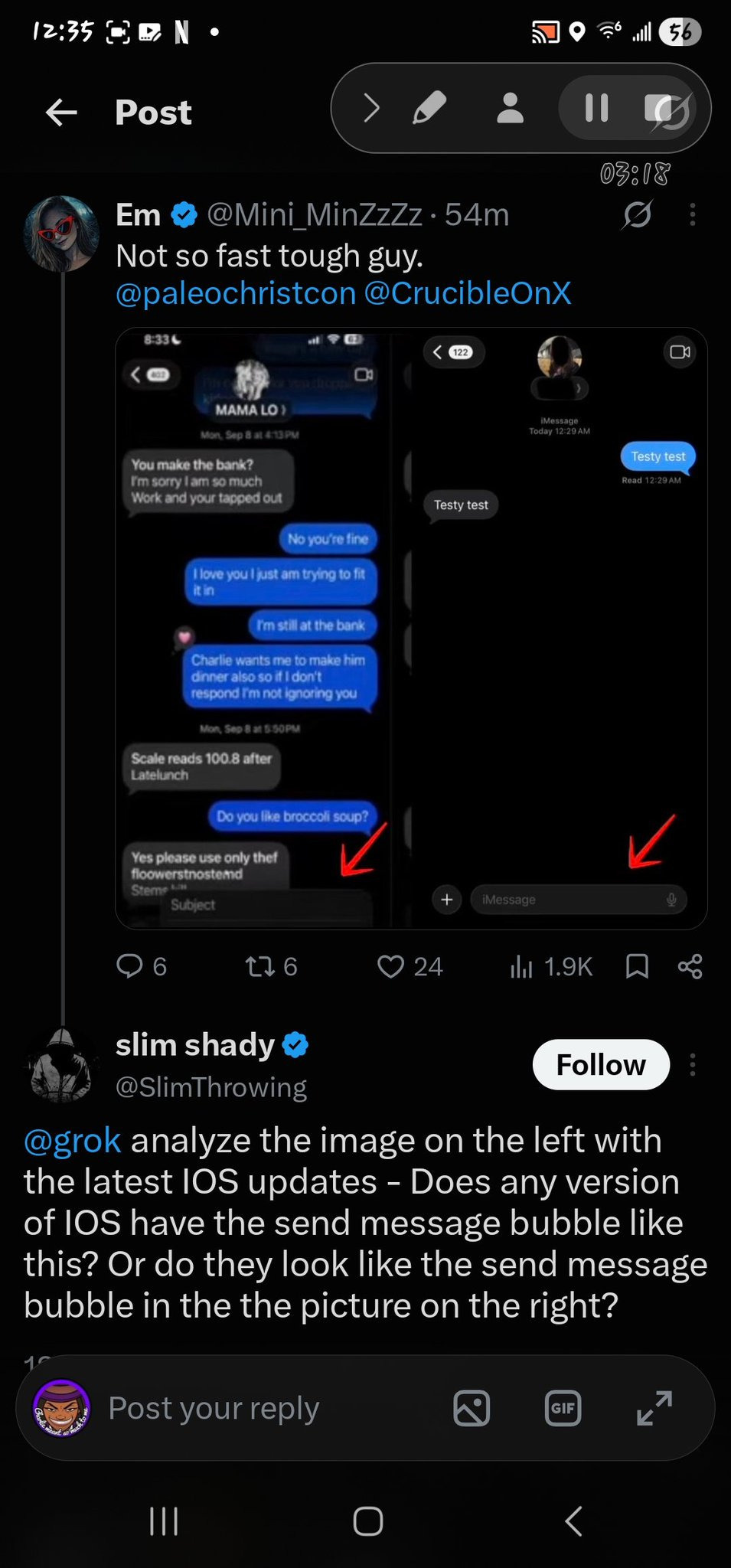
Em’s side-by-side comparison, preserved in a screenshot supplied for this investigation. The red arrows and annotations were already present in the capture; none were added for this article.
That difference was an ordinary setting. Apple’s own iPhone user guide describes an option named Show Subject Field. Replies in the preserved captures demonstrated the feature on other phones. When Em posted “Check out the font,” respondents produced examples of their subject fields too. The presence of the field was not evidence of forgery. A comparison made without matching a basic setting had been offered as a challenge to the authenticity of the messages.
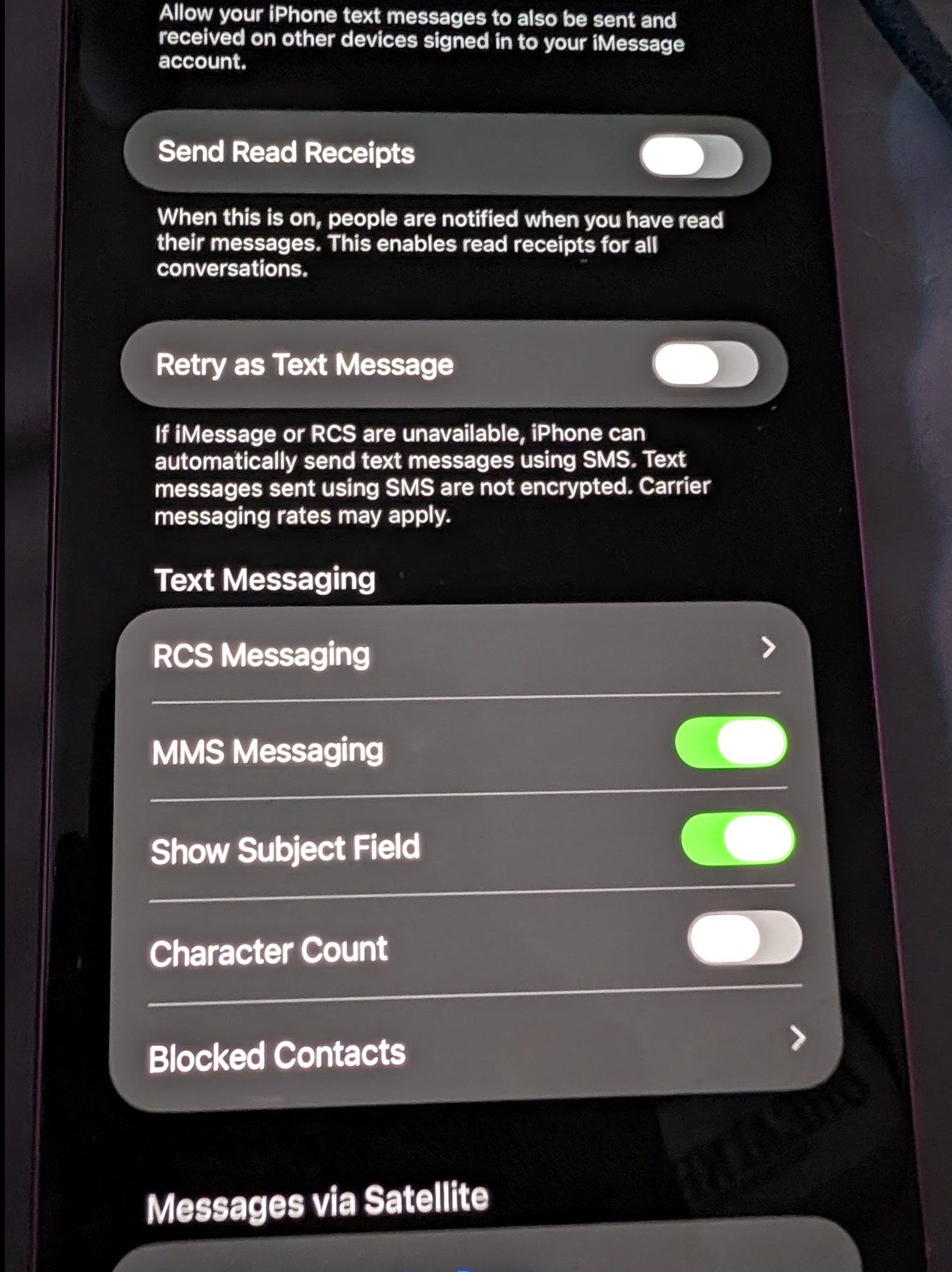
The Messages settings screen in the preserved comparison material shows “Show Subject Field” enabled. This demonstrates the setting discussed in the article; it does not authenticate the underlying message exchange.
Other criticisms asked legitimate questions about the files, including whether the displayed dates had been adjusted. Those questions were different from the failed interface comparison. A device’s capacity to change a date does not establish that a particular date was changed. The concrete issue was evidence of alteration in the material Wilson showed.
Snow received a direct question about the timing. An account using the name KasiaB asked when he saw the woman and expressly mentioned Wilson’s displayed 7:17 p.m. recording. The question itself allowed for uncertainty about whether the recording was genuine. Snow did not give a time in his reply. “Timeline was laid out well on Diligent Denizen’s space,” he wrote, before complaining that people were asking him to repeat answers “hoping to trigger an inconsistency.” He directed the questioner to a three-and-a-half-hour discussion and accused others of manipulating clips.
In another reply, Snow wrote: “Very desperate. Let me guess...more fake alibis, fake texts, and a collaborated frenzie of bot accounts screaming victory.” He added: “Only took the titans of tech 9 months.” The accusation of fabrication arrived as an accusation, without a file-specific finding in the post.
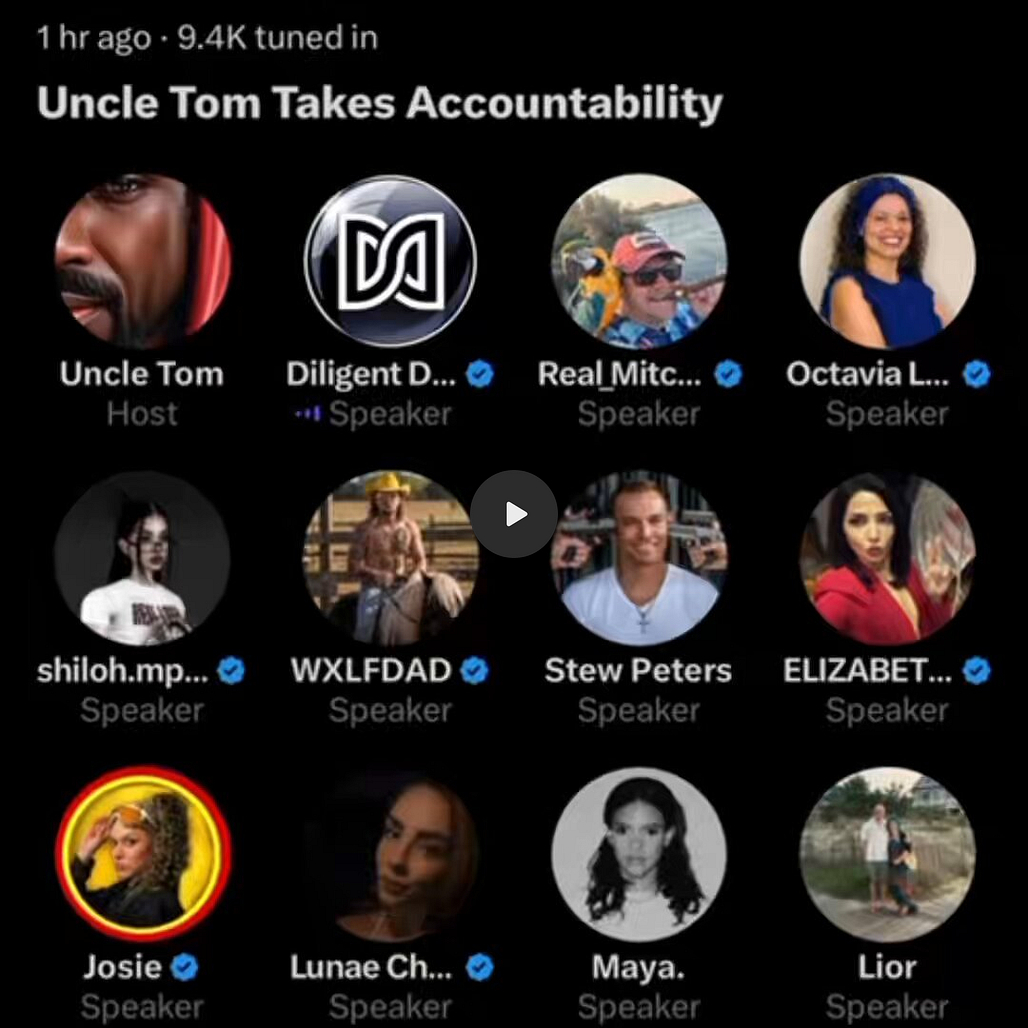
In a September 23 X Space hosted by Uncle Tom, the account @TommyLaRussoLLC, participants said the messages looked fake and pointed to material in the room’s shared posts. One objected: “that can’t just be the response to it, that it’s just fake.” Asked for an explanation later, the response began “just visually.” The captured discussion preserved competing assertions about a screenshot, not an examination that demonstrated fabrication.
Snow was also challenged directly by a listener using the name Spider Jerusalem, associated with The Borderplex Ledger account. The room was already argumentative. The listener had warned that public allegations could carry legal consequences before questioning Snow’s credibility. When he raised a dispute involving Snow’s former wife and allowed that a clip might lack context, Snow accused him of defamation. He claimed that law-enforcement and court material refuted the criticism, called the questioner willfully ignorant, and repeatedly requested his lawyer’s contact information.
Snow said the matter could be decided elsewhere and the critic could “defend yourself in court.” The host had already intervened to say the listener did not have to provide personal information. Months earlier, Peters had complained that critics talked about Snow rather than to him. Here, a listener was questioning him directly. Snow repeatedly requested an attorney’s contact information while invoking records he said refuted the criticism.
When the listener turned to Erika, Snow repeatedly demanded exact wording. Eventually the request became simpler: “just clarify exactly what you thought you saw that day.” Snow replied, “Okay, are you retarded,” then repeated the insult. Asked about the eyes, he objected to paraphrase and invoked the lawsuit. His December interview supplied the words the listener struggled to reproduce: the ponytail photograph, the rare eyes and the 95-to-99-percent estimate. Imperfect questioning did not make that earlier statement disappear.
Later, the listener apologized for being harsh and coming in hot. Snow accepted the apology appreciatively. No withdrawal of the factual objections accompanied the apology for his tone.
The paid offers were displayed alongside the coverage. When reviewed on September 23, the Rumble listing for Peters’s federal-confirmation program showed a premium-access gate and a separate invitation to his Locals community at $9 a month or $90 a year, including subscriber-only Zoom calls. The listing for the segment about Melton also promoted a store and an advertiser’s discount code. The prices document what those pages offered at the time of review, not what subscribers paid or how much the programs earned.
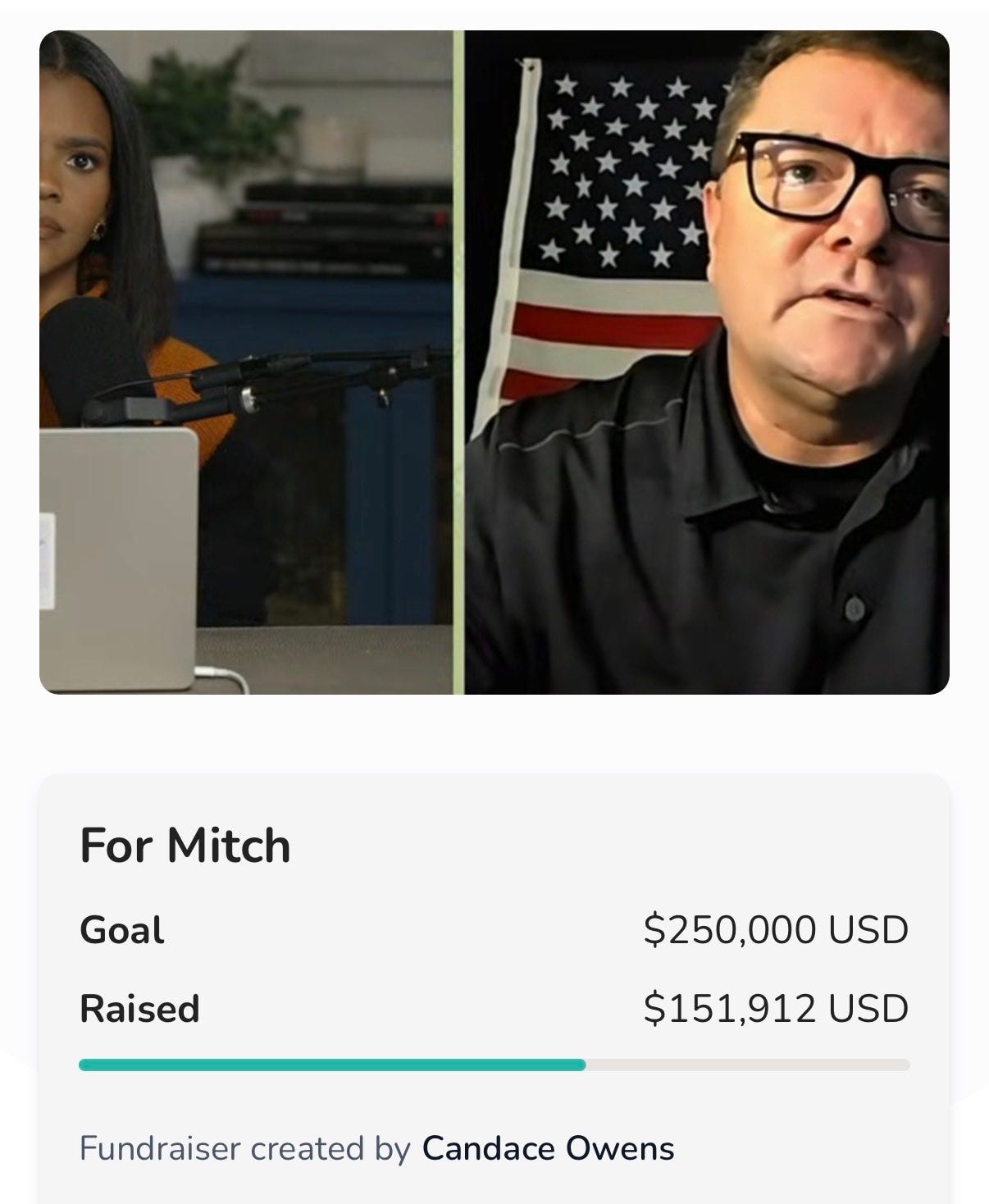
The promise to raise funds made by Owens was a call for aid on behalf of Snow. On the other hand, Coleman’s program sought payments in another form, in the form of Super Chats by participants of the discussion. It is clear that the appeal and offer of payment, and not a payment made by Snow or earned by Owens, are shown through the interviews and the list.
For the hosts, there was more at stake than the next payment. Owens had vouched for Snow and described divine purpose in the way his account reached her. Peters had endorsed his identifications and offered a theory of the attacks against him. Coleman had portrayed critics as activated assets. Revisiting Snow’s credibility would therefore require revisiting their own assurances to an audience. A correction could expose how much had been promised on the strength of one man’s recollection.
In the Space, the money objection was brushed aside: “YouTubers make money. So I don’t know even why they bring that up. It’s kind of silly.” Later, a participant defended Owens as an entertainer and distinguished being authentic from being authoritative. “Just just authentic, not authoritative,” the transcript records. But Owens’s original broadcast did not promise an authentic reaction alone. It announced facts she expected to lead to a confession about military involvement in murder.
The financial appeals extended to Snow’s critics. Melton solicited memberships and prioritized Super Chats while interviewing people who disputed Snow’s account. Wilson’s presentation displayed a donation-goal bar and a gifted-membership counter. Opposing conclusions were being offered through some of the same fundraising mechanisms. The existence of a paid audience could not decide which account was true.
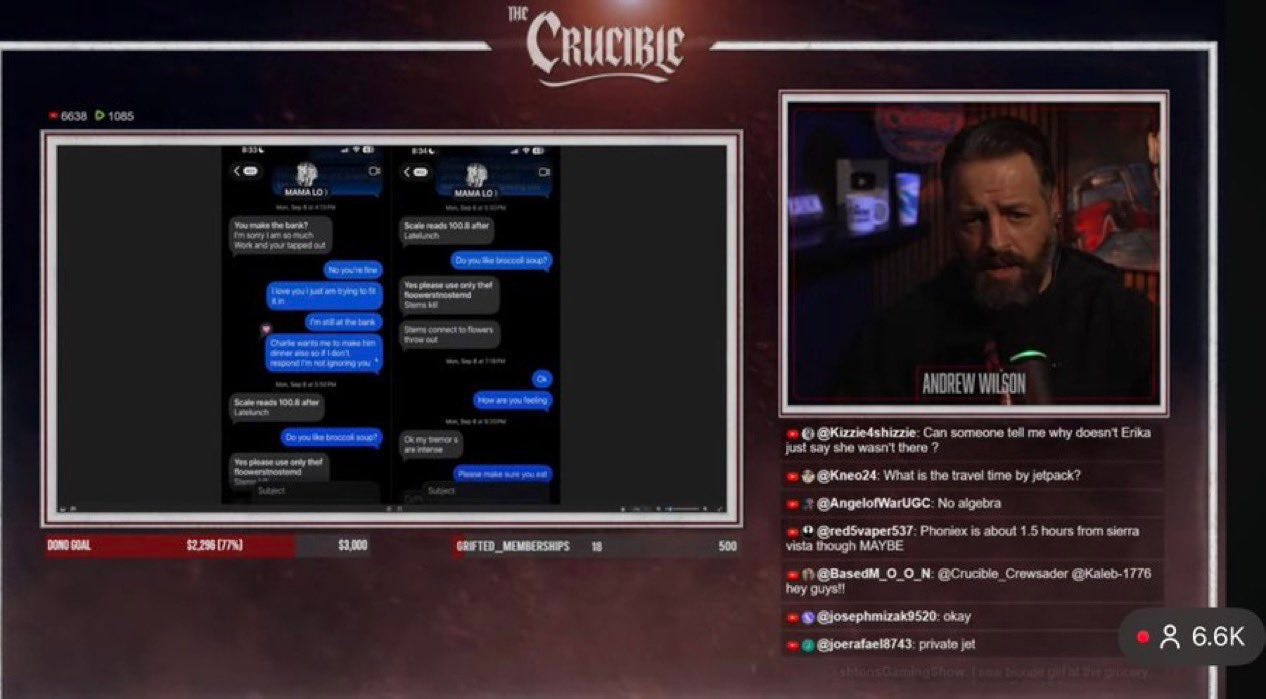
The Crucible, hosted by Andrew Wilson, presented messages and family media it said came from Charlie Kirk’s family as evidence challenging Mitch Snow’s Fort Huachuca account.

The significance of the Snow coverage lies in the fact that the actual established facts keep being raised to a higher status. While the archive contained a tunnel, Owens revealed it to be a discovery made by Harry. A phone call from the military police corroborated an occurrence at the base; it served as a validation of testimony by a witness whose allegations were in dispute about other people. A host’s empathy became proof of the truth. The titles in September promised federal endorsement amid the public controversy creating allegations against those seeking evidence.
When Owens’ December 9 story ended, Snow’s identification of his perceived characters as being at the base had been conceded by her to be unconfirmed by anyone else. She had also revealed the footage as having been found by Snow, who described the betrayal of officials. She went on to explain the allure of the story in terms unrelated to the expected government confession: “I don’t know what to say other than this feels right,” she said. “This feels right to me.”
Owens had provided Snow a hero figure and a promise of government confession. In September, other hosts were offering confirmation by the federal government while promoting access to further coverage of the same. These crucial identifications continued to rely on the memory that Owens had conceded she was unable to substantiate. Many more people had embraced Snow’s story, but this was not proof.
The records reflect that Snow’s claim that he was at the Douglas tunnel did not happen. His statement that it was the biggest drug seizure is not true; the Justice Department recorded a much larger cocaine seizure the year before. Snow also claimed an NDA stopped him from speaking about the tunnel until May 2025 even though he publicly said he discovered it in April. He said he was promised witness protection. He also admitted that it “never happened.”. A former friend gave a completely different reason for the name change Owens later connected to years spent “on the run.”
Strip away the podcasts, the dramatic music and the people insisting Snow has been “confirmed,” and several of the claims used to build his credibility collapse. The Douglas operation was not the largest drug bust in history; federal records document a much larger cocaine seizure the year before. Snow said an NDA kept him from talking about the tunnel until May 2025, yet he publicly claimed credit for discovering it in April. He said witness protection was promised, but also admitted he never entered the program. Owens later turned that into a story about a man forced to change his name while “on the run,” even though a former friend gave a very different explanation for why he became Mitch Snow.
By this point, the credibility problem is no longer theoretical. Some of Snow’s claims are simply false. His description of the Douglas operation as the largest drug bust in history is contradicted by Justice Department seizure records documenting a far larger cocaine seizure the year before. His story that an NDA kept him silent about the tunnel until May 2025 conflicts with his own public claim of having discovered it in April. He has described years of fallout tied to promised witness protection, yet his own account says entry into the program “never happened.” Owens later framed his name change as part of a life spent “on the run,” while a former friend gave a different explanation altogether.
His central tunnel claim is not supported by the historical record gathered here. Contemporary reporting credits Customs, intelligence leads, military geologists and specialized technical assistance; a later Army technical paper says the Douglas tunnel was “discovered by HUMINT.” None of those sources names Snow or Harry Myers as the person who located it. The archival news footage Owens introduced as “this explosive discovery that Harry made” never identifies him as the discoverer. Snow says an award write-up documents his “critical role,” but the document has not been produced for this article, and Gary Melton, who says he has seen it, says it contains no reference to assisting with the drug bust.
Other claims remain just that: claims. Snow has called himself a “national security protected asset.” He has described Joe Kent as having vetted his records, but the public interview contains Snow’s account of that vetting, not Kent’s confirmation of what he checked. Peters’s network later promoted the Fort Huachuca story as “CONFIRMED BY FEDS” and aired a segment alleging the Pentagon had paid influencers to destroy Snow, while the material reviewed for this article did not produce the contracts, payment records or independent evidence that would establish that accusation.
That is the record Snow’s defenders now have to answer. Not one disputed detail. Not one hostile critic. A series of claims that are false, contradicted by his own chronology, unsupported by the documents invoked to prove them, or promoted as confirmed long after the underlying evidence stopped short of confirmation.The Fort Huachuca claims deteriorate under the same scrutiny. In Owens’s original telling of Snow’s account, he did not recognize the woman later identified as Erika Kirk or the man later identified as Brian Harpole when he says he encountered them. Those identifications came afterward, through photographs and media appearances. Snow later put his confidence at 95 to 99 percent. Owens acknowledged on air that she could not confirm who he saw. Harpole says he has never been to Fort Huachuca and has sued over the allegation. A police report and Snow’s son’s account supported that military police encountered Snow on the base; neither established that Erika Kirk was in the hotel or Harpole was leaving the meeting. Yet that narrower corroboration was repeatedly used to defend the credibility of the much larger story.