


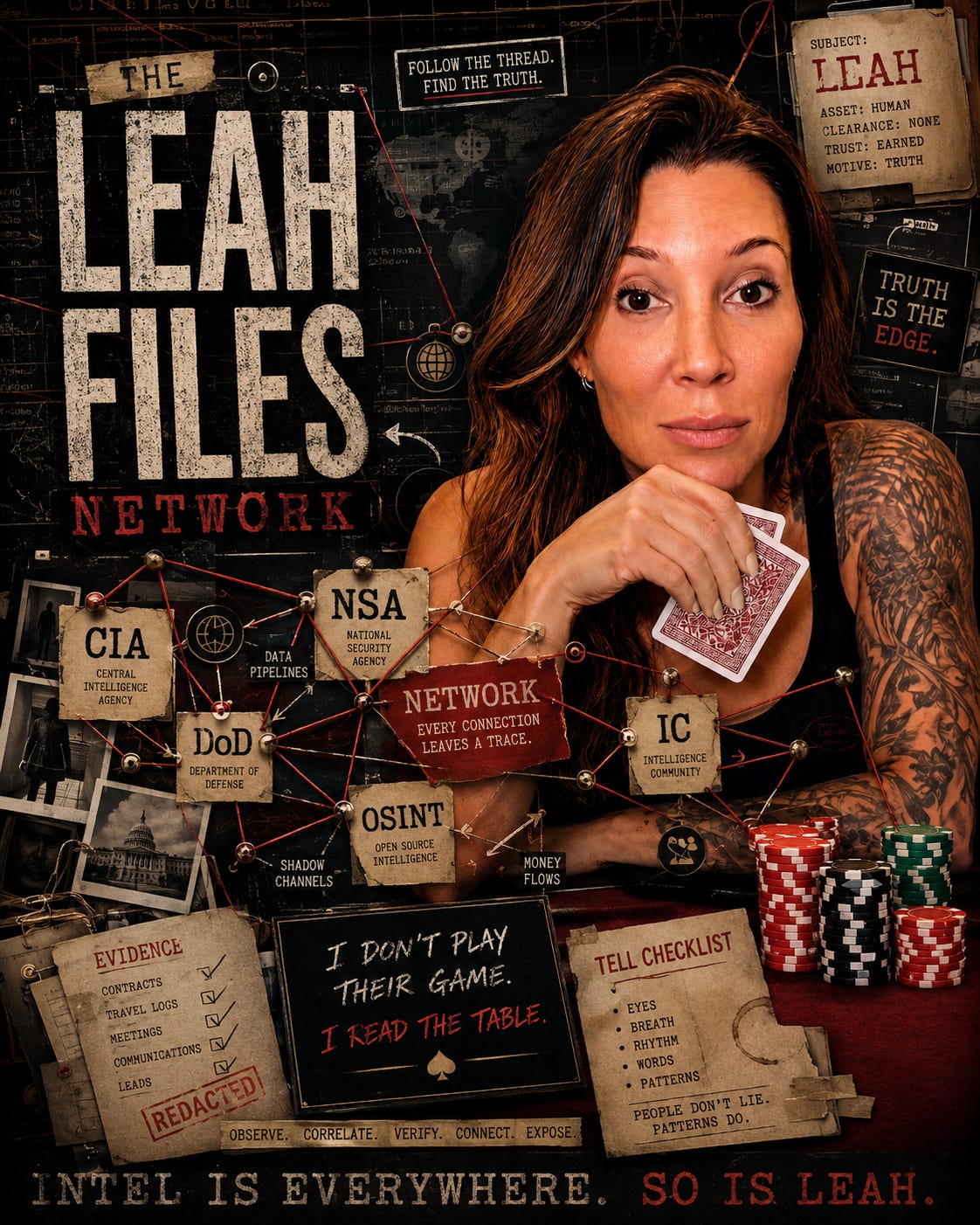
Did you know Larry Pfeiffer’s name before this? Most people didn’t. They should have.
Larry Pfeiffer spent more than three decades inside the U.S. Intelligence Community. His career reached the White House Situation Room and the office of CIA Director Michael Hayden, where he served as chief of staff. After government, he stayed in the national-security conversation. Intelligence policy. Politics. Trump. Tulsi Gabbard. The same subjects that would later run through Renn Pfeiffer’s work.
In July 2025, Gabbard appeared at a Turning Point USA conference as Director of National Intelligence. Larry reacted publicly: “Never thought I’d see a sitting US intelligence leader speaking at a Turning Point USA conference. Sigh.” Less than a year later, after Gabbard resigned, he told PBS she “should never have been nominated for the job.”
Those weren’t comments buried in some private family group chat. He said them publicly.
Larry also isn’t some distant name I found through six degrees of separation, or the one-degree-of-dumbness method conspiracy accounts use when they want a surname to do the work of evidence. He is Robert Pfeiffer’s uncle. Robert is Renn Pfeiffer’s husband. Larry is Renn’s uncle by marriage.
Which matters for a simple reason. Renn has built an audience around examining government ties, intelligence proximity, family networks, political influence, money, access, affiliations, and the people behind the people.
So I started looking at hers.
Her career started with years spent in federal consulting, and project management overseeing Government roles. Her husband followed a similar path, building his career in government contracting. Then there is her brother-in-law, Dan Pfeiffer, who worked for years at the heart of Democratic presidential communications. In this clip, he speaks as a senior adviser for the Obama White House about the NSA surveillance controversy, including the tapping of Angela Merkel’s phone. When the topic shifts to Edward Snowden, Pfeiffer says Snowden broke U.S. law and should return to the United States to face prosecution.
This is the interesting part. Renn built The Leah Files by teaching an audience to look past the obvious story. Follow the relationships. Follow the institutions. Follow the money. Follow the access. Follow the affiliations. Look at the people behind the people.
So I did exactly that to her.
By mid-July she was teasing an expected appearance with Shawn Ryan. On July 16, The Leah Files posted, “If you like Shawn Ryan….stay tuned ;)” I had already started looking into the person behind the account before that announcement. My dated research and public posts establish the sequence. The appearance never surfaced publicly. I found nothing tying its disappearance to my reporting.
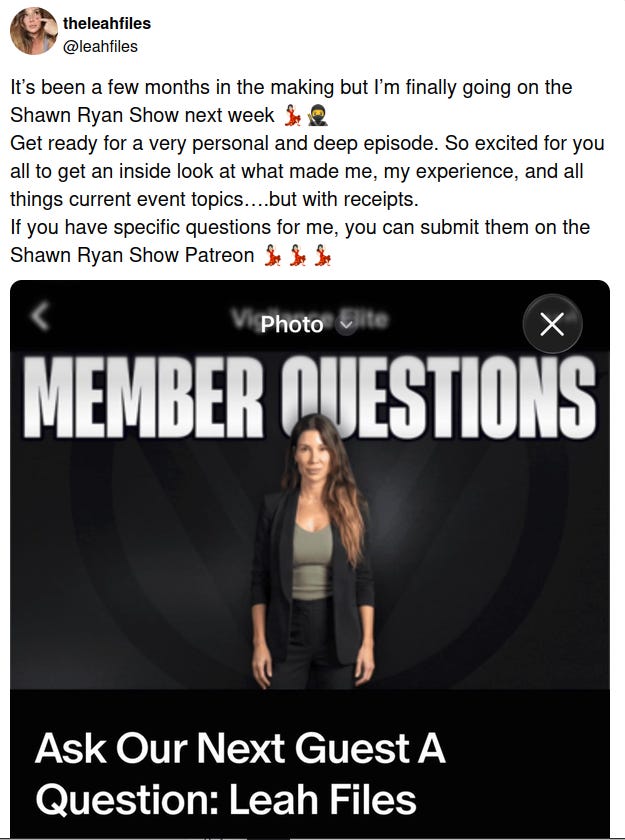
The woman behind “Leah” is Renn Pfeiffer. She has said so herself. In a July 26 video I preserved, Pfeiffer explains that Leah is her middle name and Renn her first. Records I reviewed identify her earlier as Renn Leah Watkins and later as Renn Pfeiffer.
Once I had the name, the rest started opening up.
Her resume ran through Northrop Grumman, Booz Allen Hamilton, the Department of Defense, PwC, KPMG, Grant Thornton, Torch.AI, Gonomy and Aminad Consulting. Employer records, corporate filings and Pfeiffer’s own statements support much of the chronology.
Then came the better question. What did those jobs mean?
Pfeiffer has publicly described supporting the National Geospatial-Intelligence Agency, National Reconnaissance Office, Defense Intelligence Agency, CIA, NSA, IARPA, the Marine Corps, Navy and Senate. In the July 26 video she walks through parts of the history herself. Northrop Grumman put her on NGA work, she says. At Booz Allen she supported NRO and DIA. A DIA client later hired her “as a govy.”
Then she gets to the two names most likely to stop an audience cold.
“I spent most of my time at NSA and CIA, which is why I say I worked at NSA and CIA.” - Renn Leah Pfeiffer
There it is.
Pfeiffer knows the distinction. She explains the distinction. PwC was the employer. CIA and NSA were clients she supported. Yet CIA and NSA are the credentials repeatedly placed out front.
Contractor work inside the Intelligence Community is serious work. Edward Snowden is an obvious example. Someone employed by a private contractor might work inside an agency environment, hold access, support agency missions, and operate beside government personnel without being an employee of the agency itself.
Which cuts both ways.
If Pfeiffer wants the authority carried by “I worked at CIA and NSA,” the employment relationship belongs in the same sentence. Not several minutes later, once somebody starts checking the resume.
And this is where her own method starts getting uncomfortable.
Pfeiffer asks audiences to parse other people’s government connections for hidden meaning. Her own government connections deserve the same precision.
“I supported CIA while employed by PwC” and “I was a CIA employee” are different statements. Pfeiffer appears to understand the difference perfectly well when her own career is being described.
Does she extend the same precision to everyone else?
Read her posts.


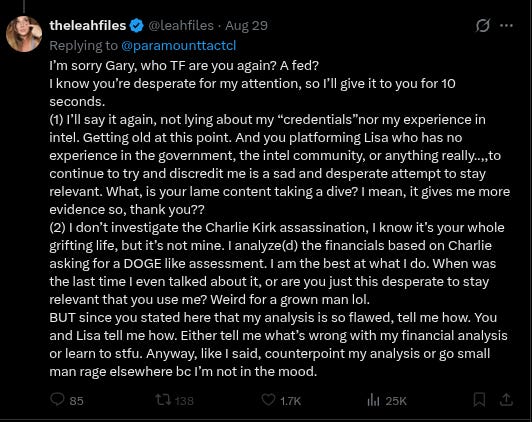
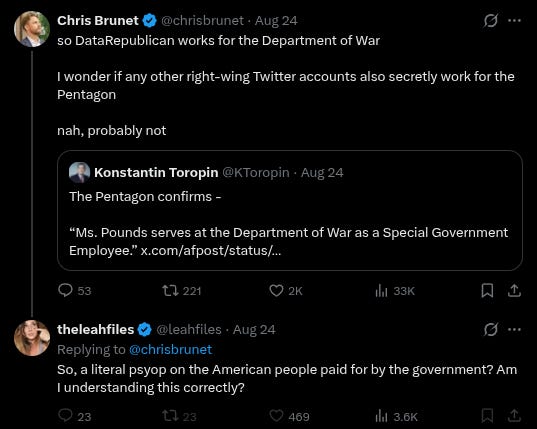
“The psyop game is honestly pathetic now.”
What evidence turns someone into a “fed” in Pfeiffer’s reporting? What turns government money into a “psyop”? How much weight does she put on employers, relatives, political affiliations, professional networks, contracts, access and institutional proximity?
Because once those things become evidence in her work, they become evidence worth examining in hers.
Take Aminad Consulting.
Company records described Pfeiffer as a Principal with roughly 19 years of consulting experience across the Intelligence Community, Department of Defense and civilian government. Archived material identified her working on a Marine Corps Supply Chain Transformation project, leading technology and operations workstreams.
That matters. Pfeiffer did not pick up intelligence and defense language from social media last year. She spent years in federal consulting around defense and Intelligence Community clients.
And again, her own explanation brings us back to CIA and NSA.
“I spent most of my time at NSA and CIA, which is why I say I worked at NSA and CIA.”
The agencies were clients. PwC was the employer.
If the phrase “worked at CIA and NSA” carries authority when Pfeiffer says it, then the distinction between agency and contractor matters when she says it too.
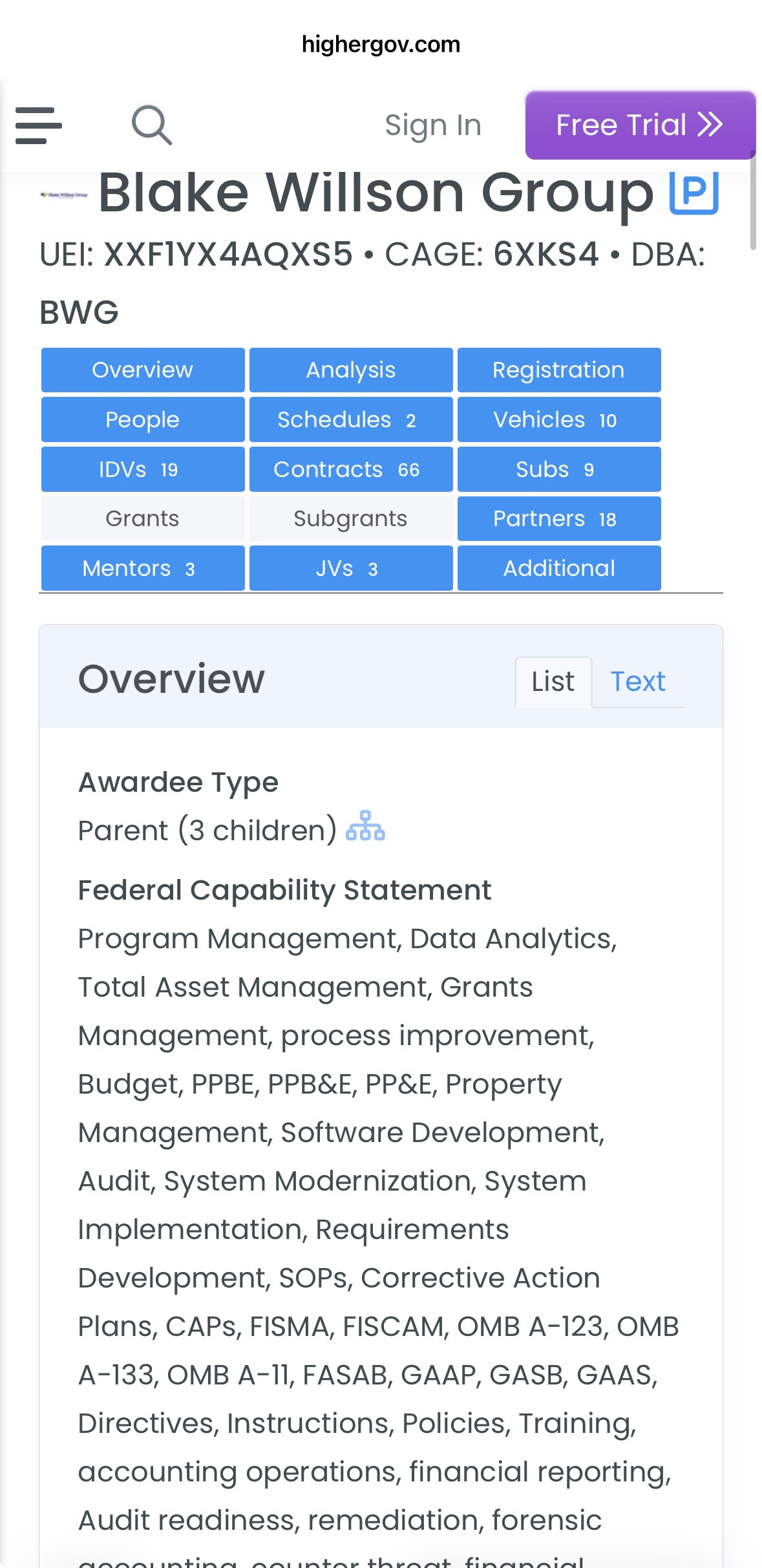
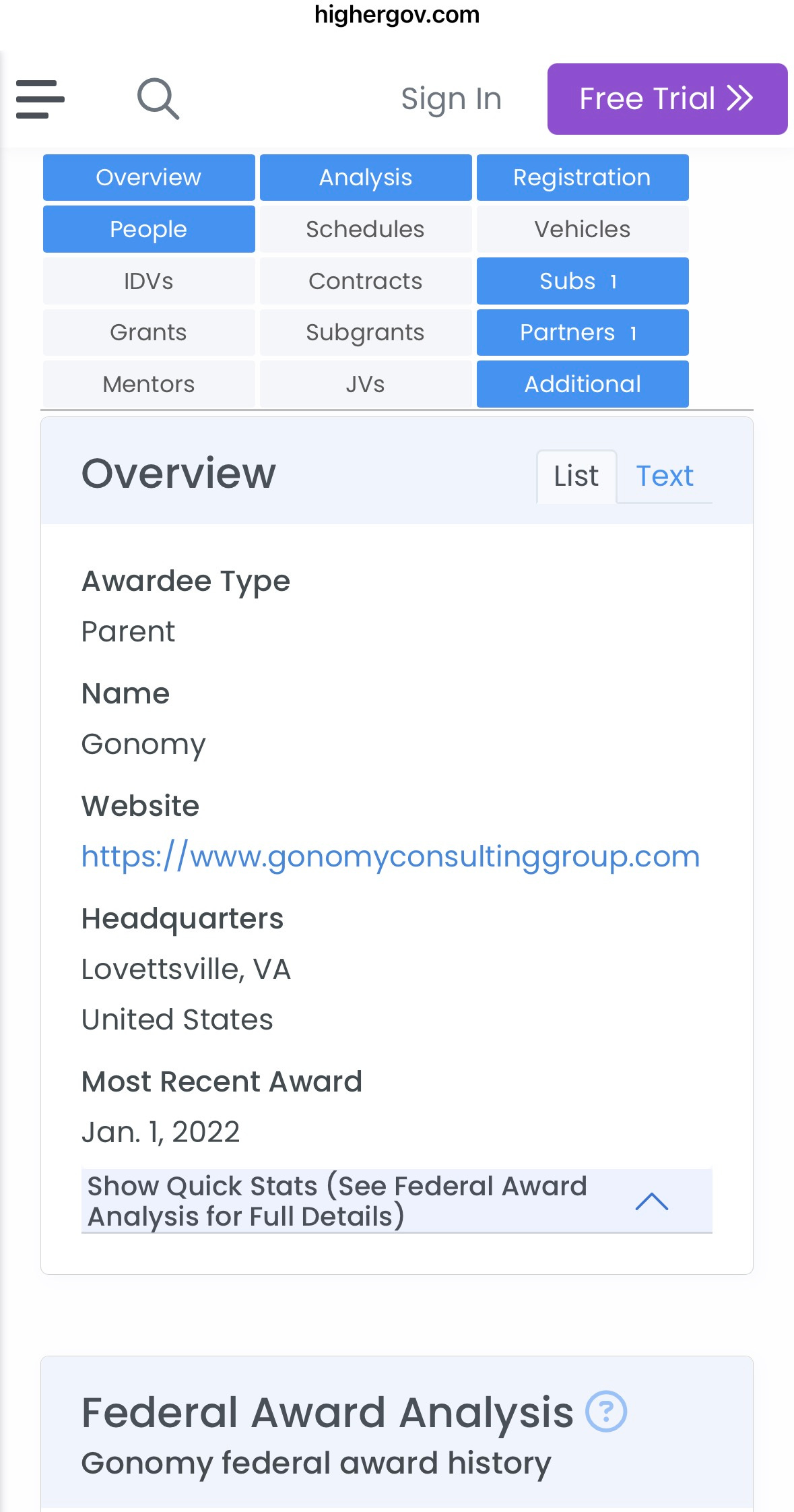
Virginia corporate records add another piece. GONOMY LLC was organized in 2021 with Renn Pfeiffer as organizer. In 2023 she signed the company’s cancellation as manager. HigherGov, a secondary procurement database, reports Gonomy as a subcontractor to Blake Willson Group on USDA Rural Development work and attributes roughly $75,000 to the subcontract.
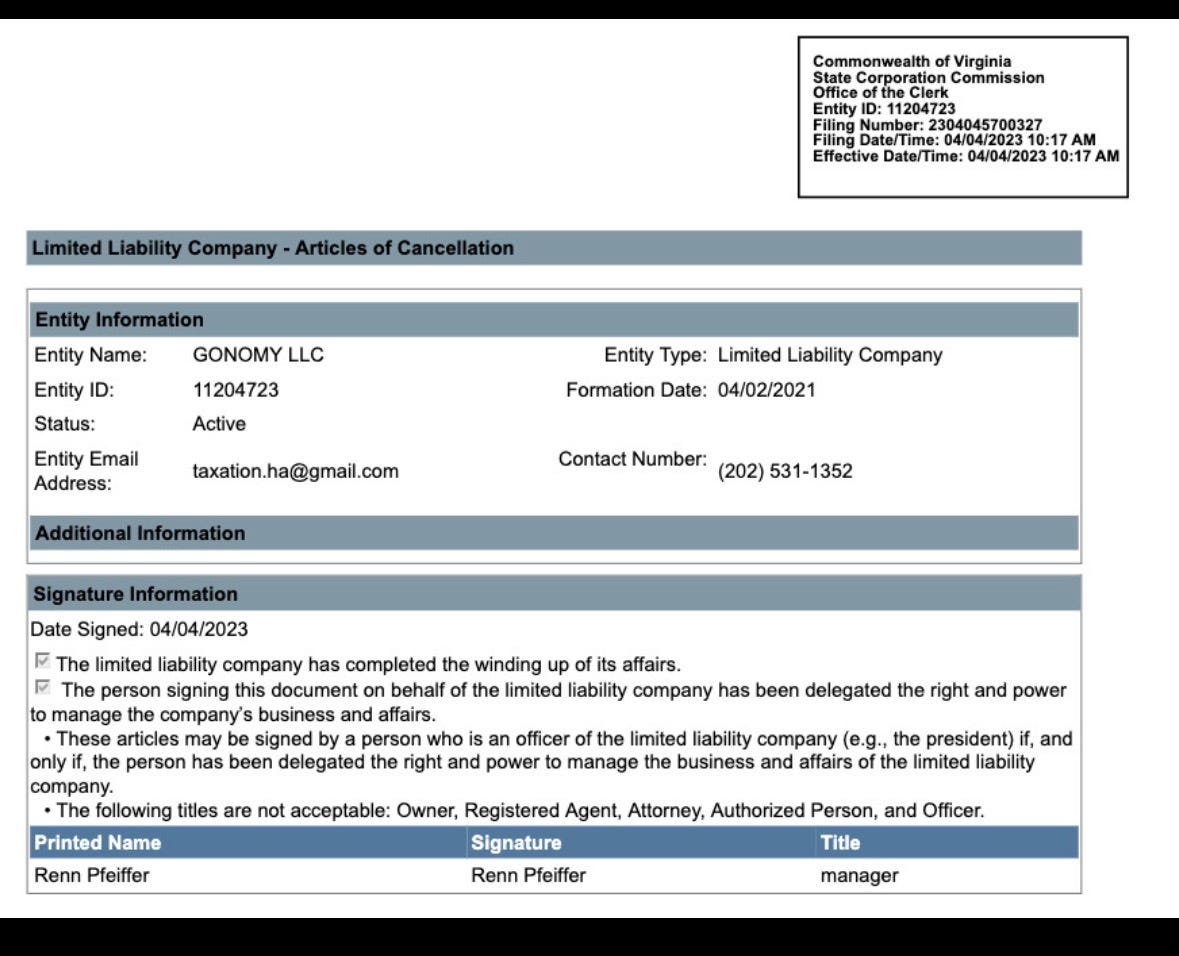
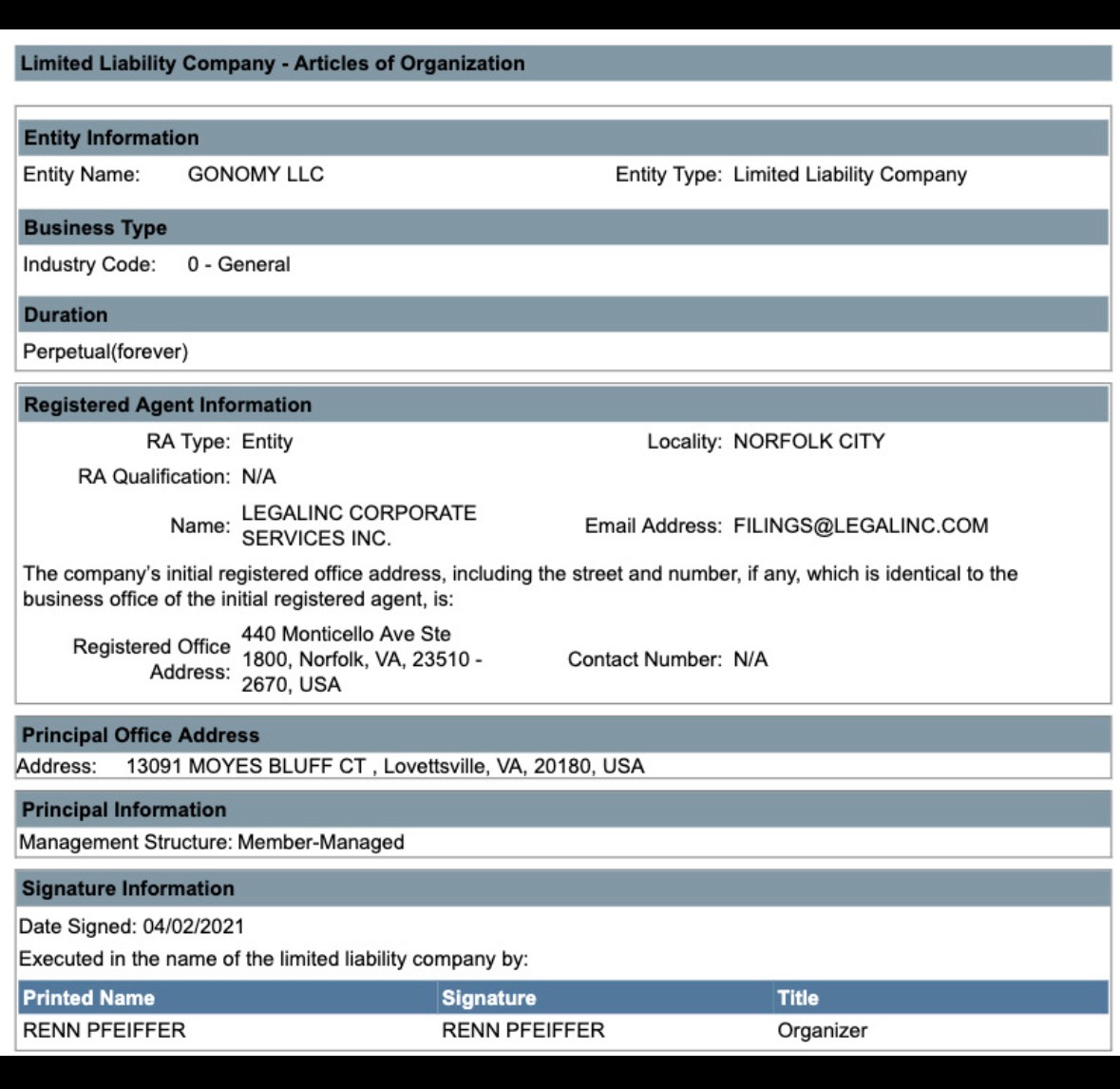
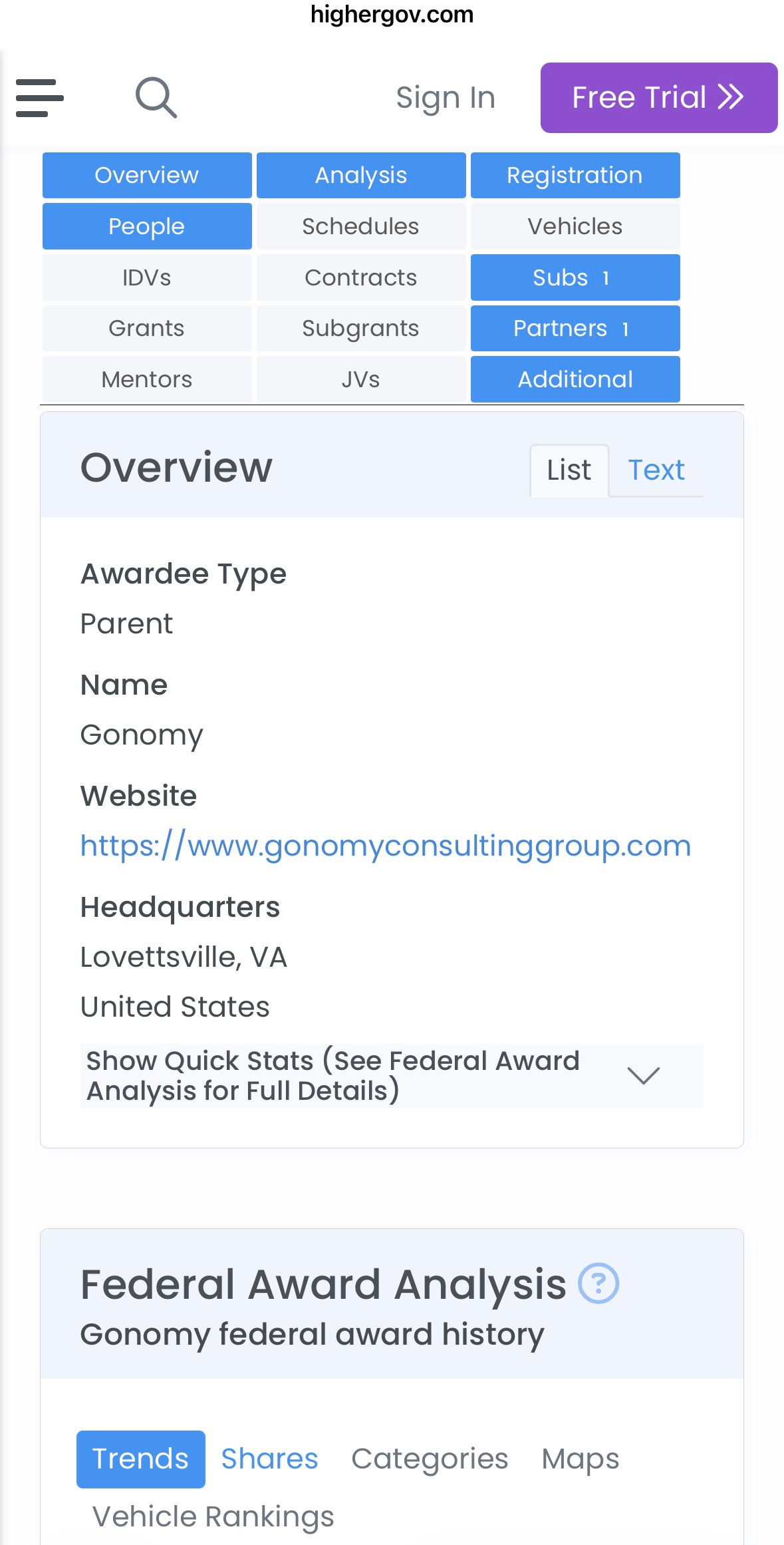
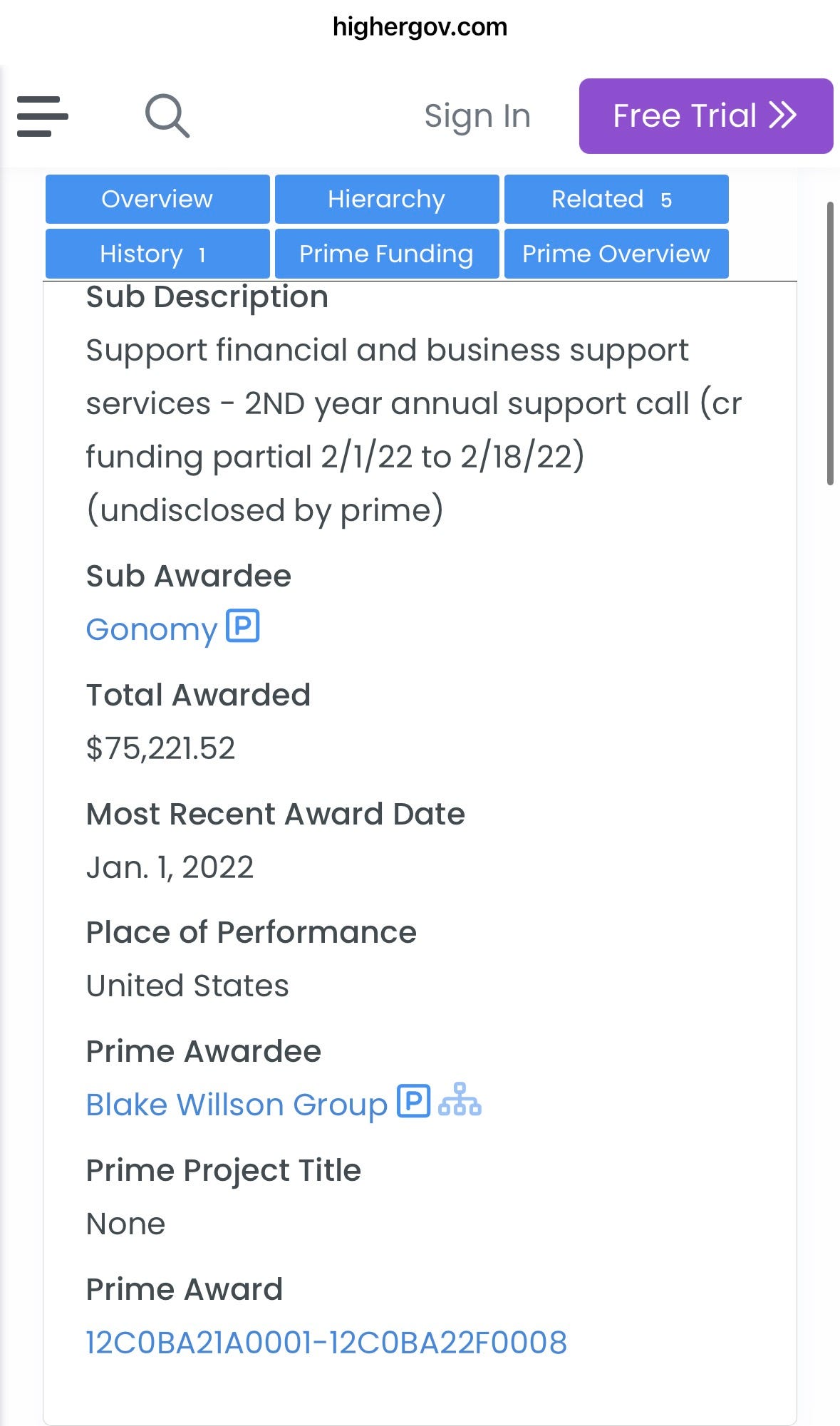

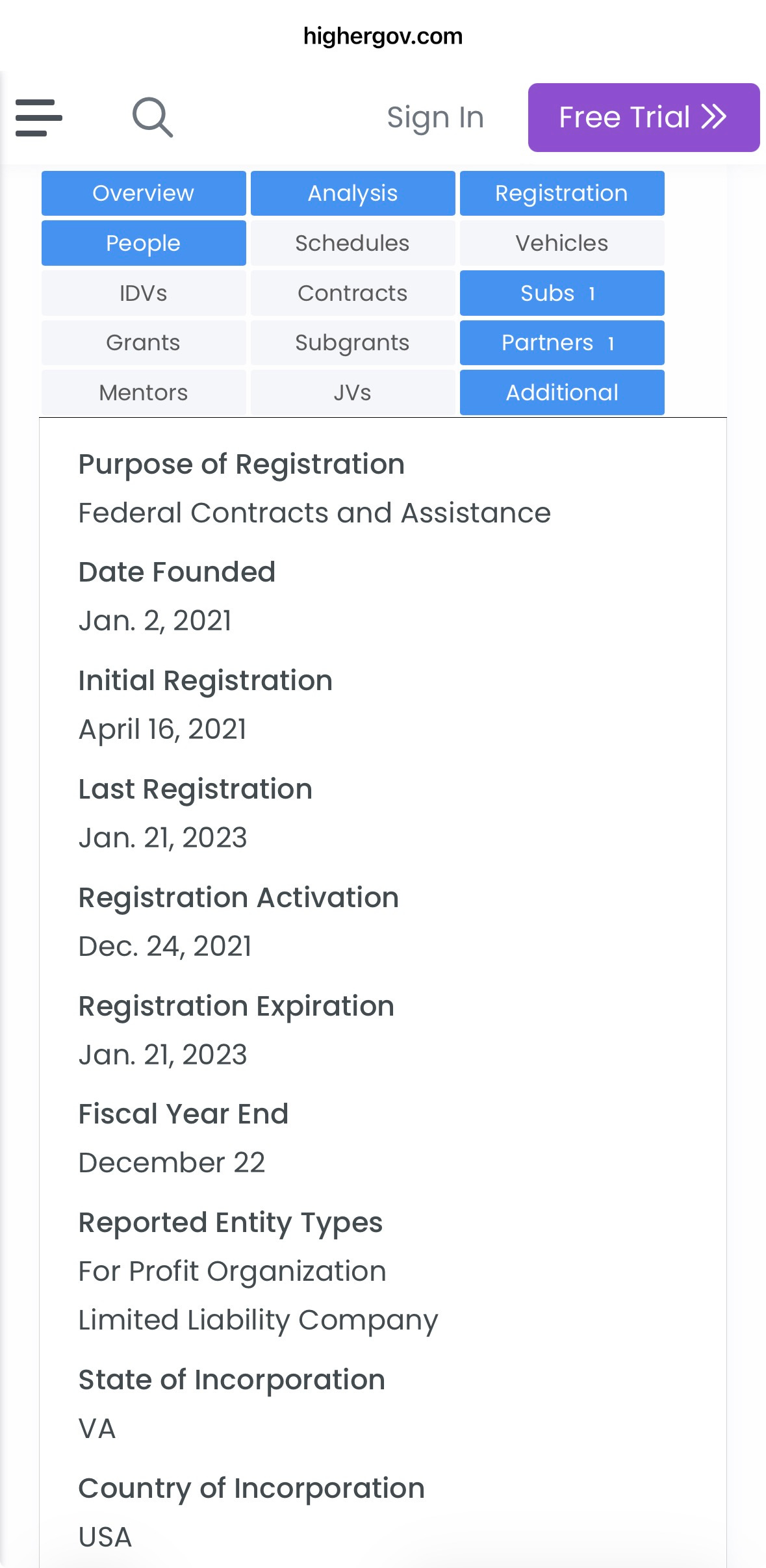
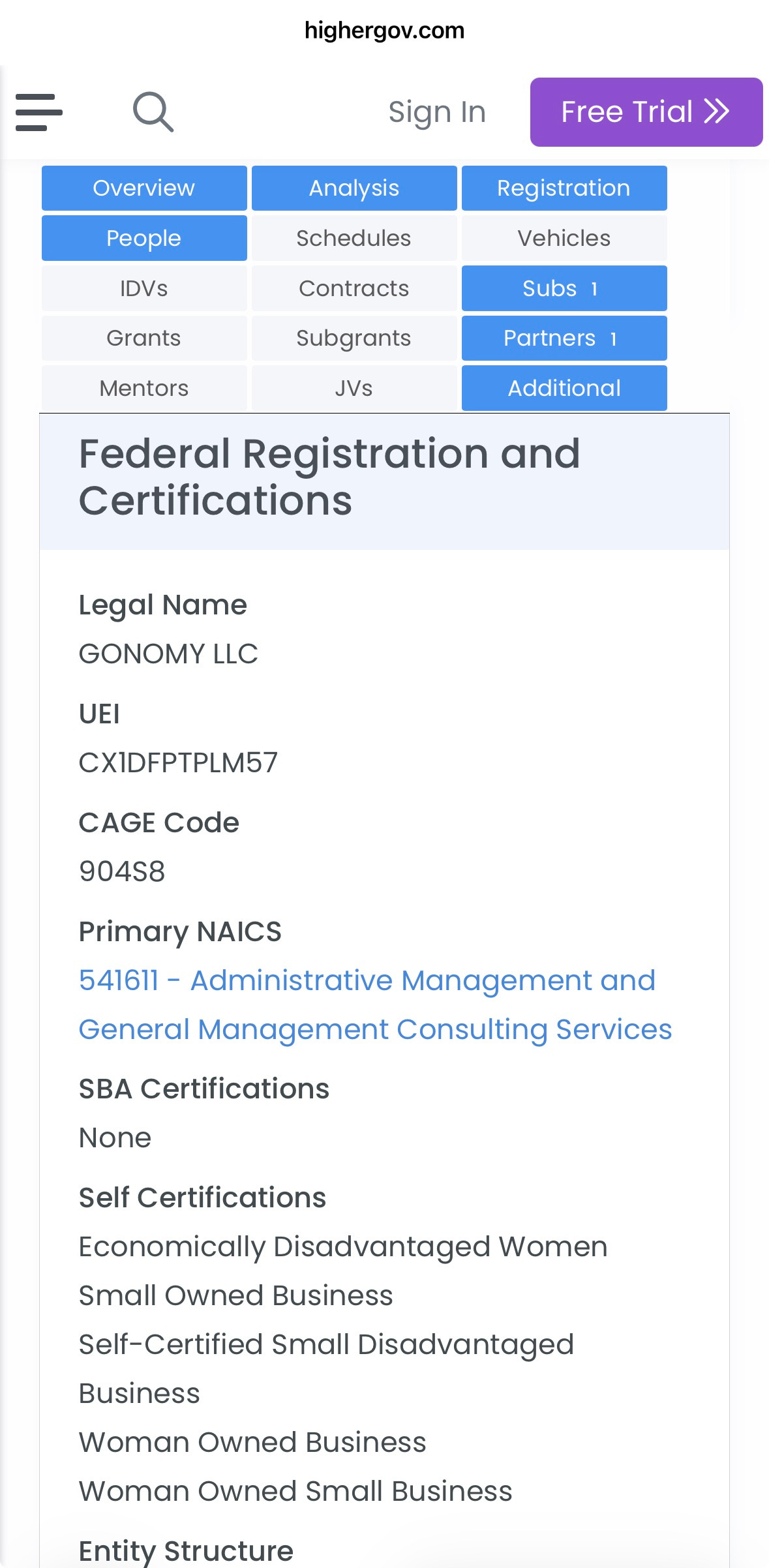

I initially considered whether Gonomy still existed through another state or served as some current vehicle behind The Leah Files. The Virginia record cut against that theory. The company was cancelled in 2023. Leah confirmed this was not the case herself, through DM’s.
Pfeiffer’s maiden name is Watkins. Her husband, Robert Pfeiffer, has been associated with Watkins Government Services. Probably just a coincidence.
Coincidence might be enough for a conspiracy thread. It isn’t enough for me. Robert himself is more interesting. His career runs through the same federal-contracting world Renn knows well. Watkins Government Services describes him as a Senior Manager with more than 18 years supporting Defense Department and civilian agencies.
The government orbit around Renn does not stop with her resume. It reaches home. And then something else started happening. Robert’s professional footprint began getting harder to find in places where I had already found it. Bios disappeared. References changed. Public-facing material vanished from multiple sources after those records became relevant to the investigation. I had already archived what I found


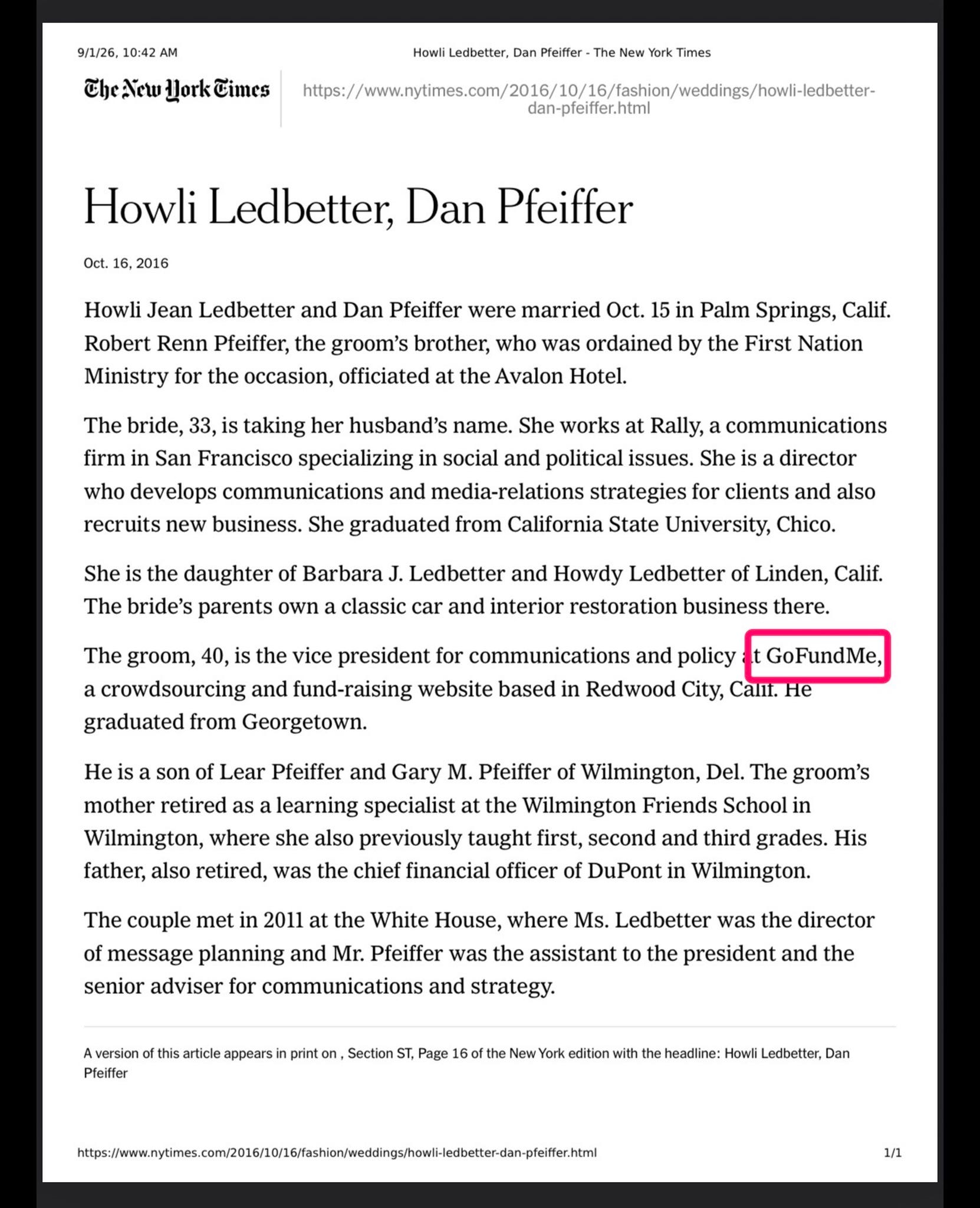
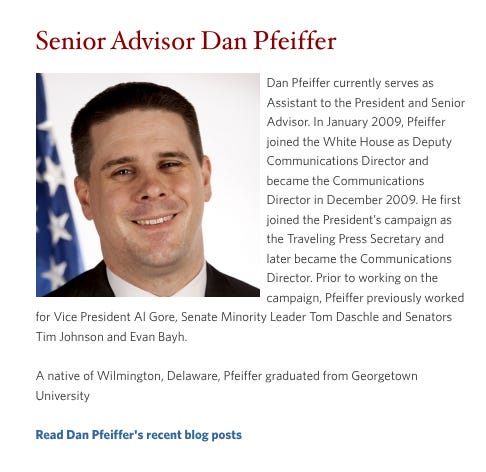
Then there is Dan Pfeiffer. This wasn’t a social-media surname match. A New York Times wedding announcement for Dan Pfeiffer and Howli Ledbetter identifies “Robert Renn Pfeiffer, the groom’s brother” as the person who officiated the ceremony. Robert is Dan’s brother. Dan is Renn’s brother-in-law. Dan Pfeiffer did not spend his career on the edge of politics. His career was political communications. Barack Obama’s presidential campaign. The White House. Senior communications roles. Assistant to the President. Senior Advisor. Then Crooked Media and Pod Save America.
So ask the question Renn’s own method invites.
Does any of that expertise or access flow into The Leah Files? Has Dan ever suggested a target? Shared information? Discussed messaging? Helped shape a narrative? Talked through political or media pressure? If family, access, institutional proximity and political influence matter when Renn examines somebody else, why would those subjects suddenly become off limits inside her own family?
Then there is Larry Pfeiffer. And this one gets much closer to the intelligence world Renn talks about so often.
Larry Pfeiffer discussing Tulsi Gabbard’s qualifications and tenure as DNI, including his statement that she “should never have been nominated” — PBS NewsHour, May 22, 2026
“She should never have been nominated for the job.” - Larry Pfeiffer
That was Larry Pfeiffer talking about Tulsi Gabbard in May 2026. He went further. He accused her of embracing Trump’s desire to revisit “conspiracy theories that were discredited” around past elections. Larry wasn’t talking from the cheap seats. He spent more than three decades in the Intelligence Community, served as chief of staff to CIA Director Michael Hayden, and worked inside the post-9/11 intelligence reform world. He is also Robert Pfeiffer’s uncle. Renn’s uncle by marriage.
First-party family material identifies Bill Pfeiffer as Robert’s father and Bill and Larry as brothers. Larry is Robert’s uncle.
Larry’s career takes far less reconstruction. More than three decades in U.S. intelligence. Senior leadership in the White House Situation Room. Chief of staff to CIA Director Michael Hayden. Later, director of George Mason University’s Michael V. Hayden Center for Intelligence, Policy, and International Security.
His political record is public too.
Larry broke with Donald Trump. He criticized Tulsi Gabbard’s nomination and tenure as Director of National Intelligence. A January 2025 presidential action targeted the security clearances of former intelligence officials associated with the 2020 Hunter Biden laptop letter, including Larry.
Then there is Turning Point USA and an organized campaign against them. On July 13, 2025, Larry quote-posted video of Gabbard appearing at a Turning Point USA event.
“Never thought I’d see a sitting US intelligence leader speaking at a Turning Point USA conference. Sigh.” - Larry Pfeiffer
No interpretation needed. Those are his words.


In May 2026, after Gabbard announced her resignation as DNI, PBS NewsHour interviewed Larry about her tenure. He said she “should never have been nominated” and criticized her qualifications and the direction of the intelligence apparatus under Trump.
Larry Pfeiffer, former senior U.S. intelligence official and former chief of staff to the CIA director, discusses Tulsi Gabbard’s record as Director of National Intelligence. In this excerpt, Pfeiffer says Gabbard “should never have been nominated for the job” and explains his concerns about her experience and qualifications to lead the U.S. intelligence community. PBS NewsHour, May 22, 2026.
Now look at the overlap.
Renn Pfeiffer’s close family includes a former senior intelligence official who has spoken publicly about Trump, Gabbard and Turning Point USA. Those political worlds also appear in Renn’s work.
That is worth examining.
Who does Pfeiffer investigate? Who gets called a fed? When does she invoke government connections? Who gets the psyop treatment? Does she apply the same skepticism across political lines? Does one side get sprawling association maps while the other gets context and qualification?
Those are empirical questions.
Answer them with the posts.
The family tree matters because Pfeiffer made proximity part of her own evidentiary vocabulary. Once “fed,” “psyop,” government money, hidden influence, institutional access and family networks enter the analysis, the threshold matters.
How close is close enough?
And does her threshold change when the connections are hers?
The formal meaning of psychological operations is specific. Online, “psyop” gets thrown around much more loosely. Somebody has a government contract. Somebody worked for an agency. A nonprofit got federal money. A relative worked in politics. Put the names on a screen, draw enough lines, and suspicion starts doing the work evidence hasn’t done.
Run that same method against Pfeiffer and look at what appears.
A long federal consulting history. Intelligence Community clients. CIA and NSA work performed through private employers. A husband in federal contracting. A brother-in-law who spent years inside Democratic presidential communications. An uncle by marriage who spent decades inside U.S. intelligence and later spoke publicly about Trump, Gabbard and TPUSA.
Those facts exist.
Pfeiffer’s own explanation of CIA and NSA also proves why language matters. “Worked at CIA” leaves out part of the employment relationship. PwC employed her.
She wants that distinction understood when the file belongs to her.
Then the scrutiny became personal.
Pfeiffer later described my use of family photographs as doxxing.
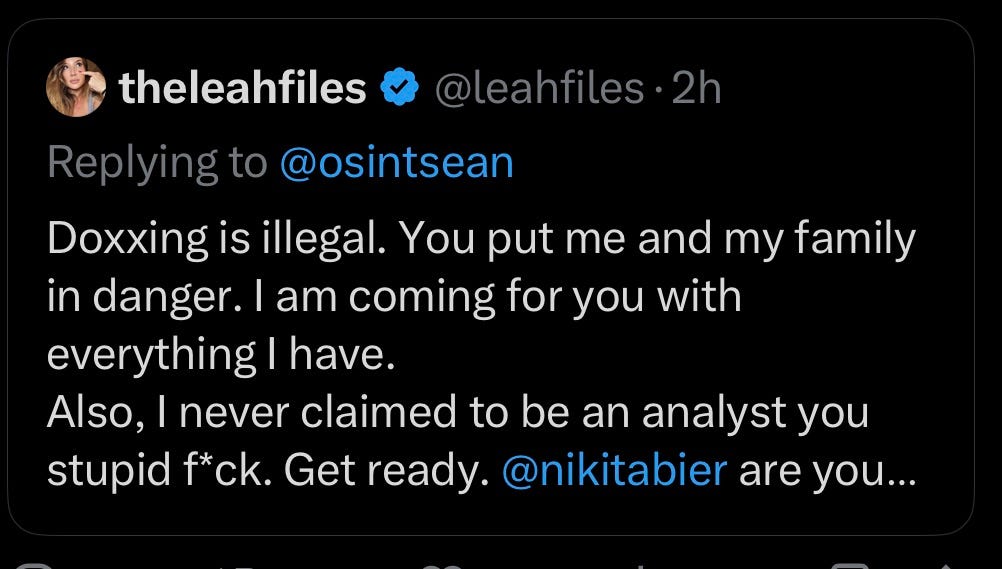
The photographs were not private. She had provided them to her employer. Her employer posted them publicly across social media, where they remained available for an extended period. The image I used was blurry, already public, and included while reporting on her identity. I did not publish a private address, school, schedule, medical information or some secretly obtained family photograph.

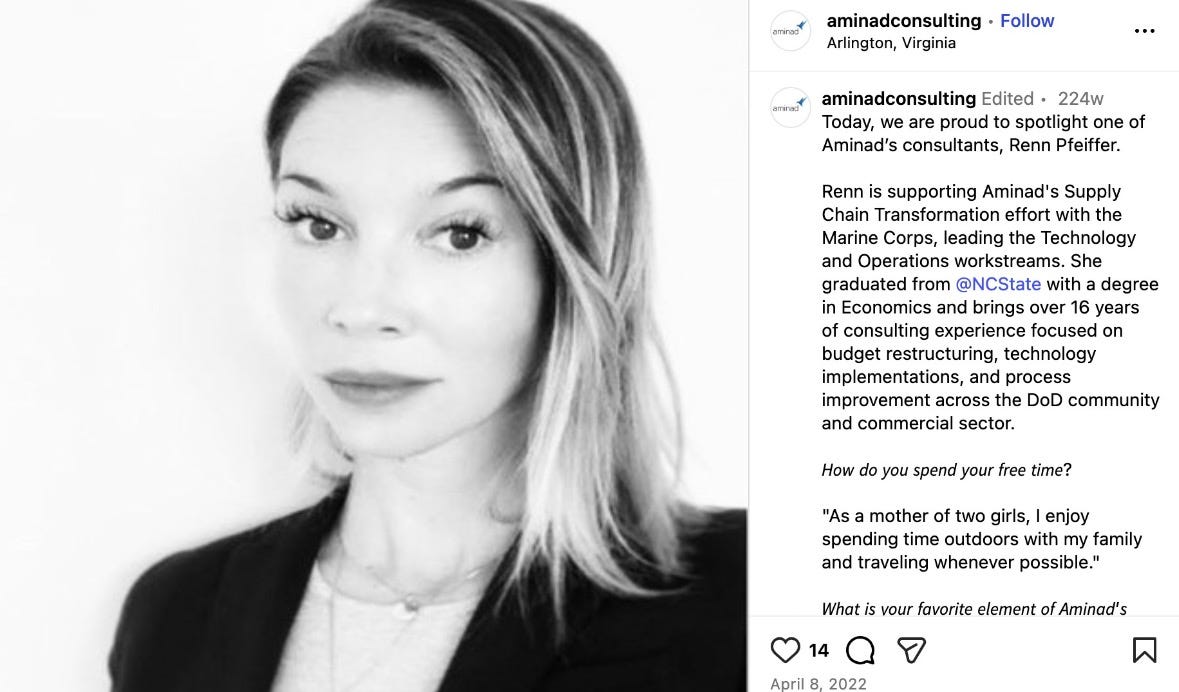
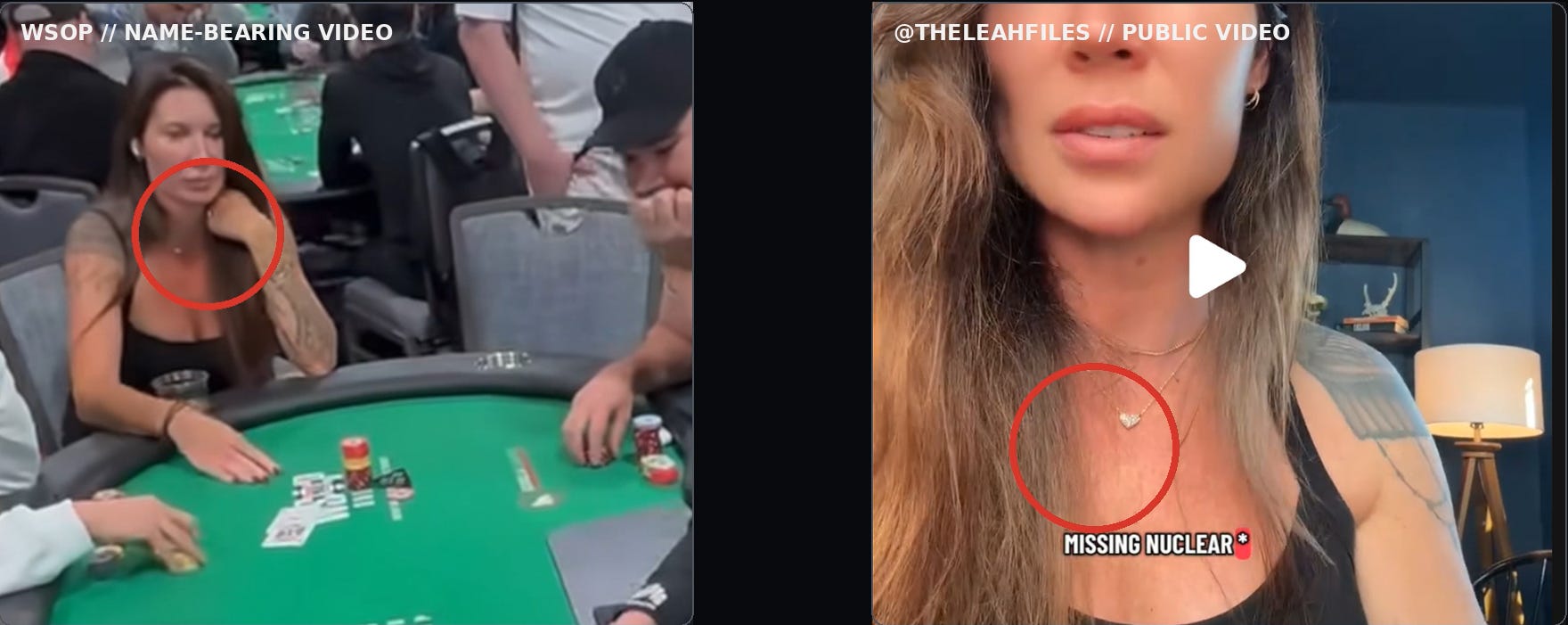
These were photos available on X, Linkedin, corporate websites, and Instagram. There were photos that were distributed by The Leah Files and given to her former employer. She then claims I used an illegal database to access them, which is far from the truth, as I will demonstrate.
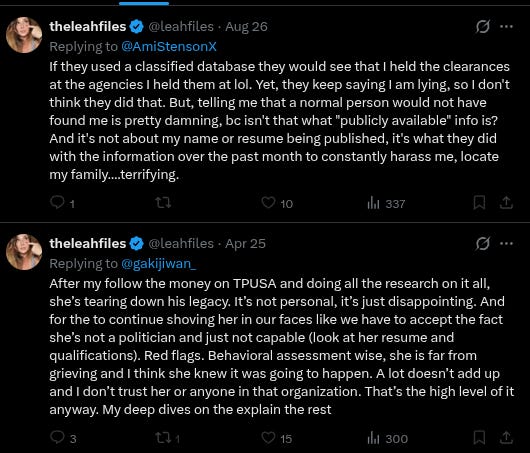
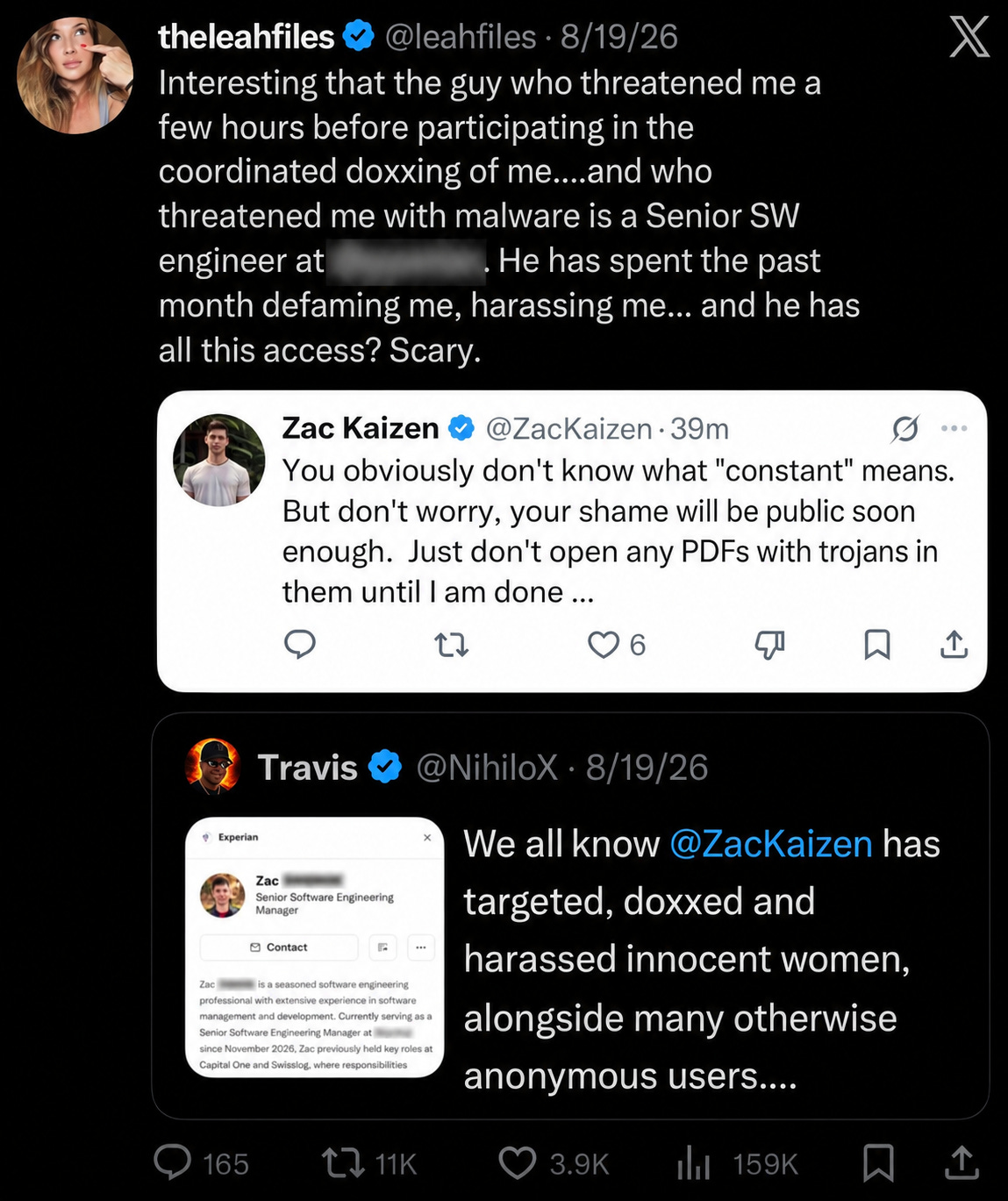
Meanwhile, the Intelius material circulated about me contained a relative’s residential address and criminal-history material presented under my identity.
The criminal entry was not mine.
I am not republishing the address. Where my father lives is not the story. The fact his address entered a dispute over Renn Pfeiffer’s professional claims is.
And July was only the beginning.
Over the next several weeks, the story around me metastasized. I was accused of doxxing, stalking, threats, database abuse, hiding a criminal past, government connections, TPUSA connections, foreign spy planes and, somehow, probably Zoltan.
The accusations moved across the same cluster of accounts reacting to my reporting on Pfeiffer. Some originated claims. Others repeated them. Others added details and carried them into new threads and Spaces.
By then Renn Pfeiffer’s background had almost disappeared from the conversation.
I was the story.
The bad guy.
The guy they felt entitled to do things to while accusing me of doing those same things to them.
On an Space hosted by Blake Bednarz, Aug. 25–26, a participant using the handle shadyladykady “Elizabeth Nunez” discussed violence against me and referenced “five grand” in the same exchange. I preserved the full twelve-hour recording and its hashes. The significance of that statement depends on the exact wording and context, which is why the audio matters more than anyone’s later characterization of it.
My preserved evidence records a later escalation inside an X Space hosted by Blake Bednarz. A participant identified in the recording as “shadyladykady” is heard condoning violence against me and, elsewhere in the recording, referring to “five grand” and saying “go fuck him up.” You may recognize her justification for escalation of violence: “Don’t fuck with women and their kids.”
When probed to show evidence of this, all of theses accusers deflect, and I believe there is a reason for this. Because while it’s alleged I may have taken their anonymity away for harassment, they were never doxxed, nor was anyone threatened by me.
I preserved the original recording and reported the matter to police.
Psychologist Jennifer Freyd gave one response pattern a name in 1997: DARVO. Deny, Attack, Reverse Victim and Offender. The sequence is straightforward. Deny the conduct. Attack the person raising it. Reverse the roles until the accused is presented as the victim and the person raising the issue becomes the offender.
Freyd also made an important point from the beginning:
“denial is not evidence of guilt.”
Then researchers started testing what DARVO does.
In 2017, Sarah Harsey, Eileen Zurbriggen and Freyd examined reports from people who confronted someone over wrongdoing. Denial, attacks and role reversal often appeared together. Greater DARVO exposure was also associated with greater self-blame among the people doing the confronting. Then Harsey and Freyd tested the audience.
Their 2020 experiments found exposure to a DARVO response changed how observers assigned credibility and responsibility. The person using DARVO was judged more favorably. The person confronting them was judged less favorably.
A 2023 experiment with 230 participants found the same basic effect. After seeing a DARVO response, observers rated the accused as less abusive, less responsible and more believable. The other person was rated as more abusive and less believable. Participants also became more willing to punish the person making the accusation.
That part caught my attention.
The Leah Files does not operate in a private room.
There is always an audience.
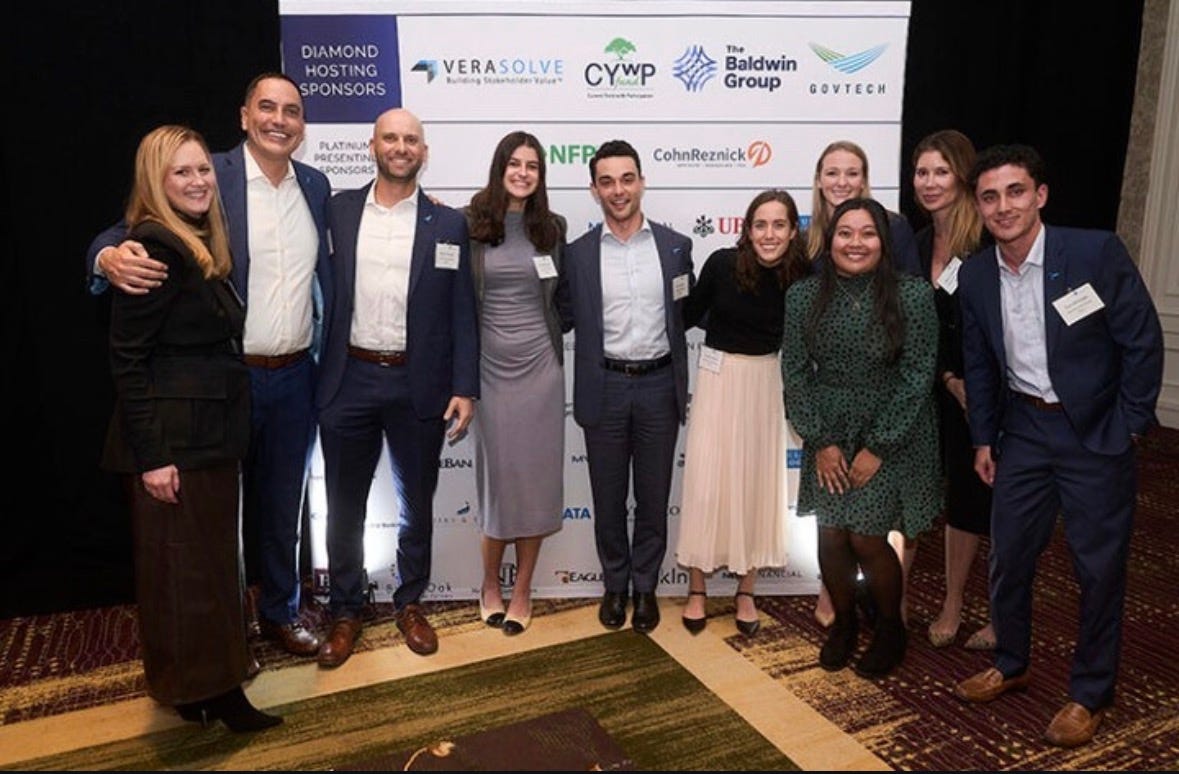
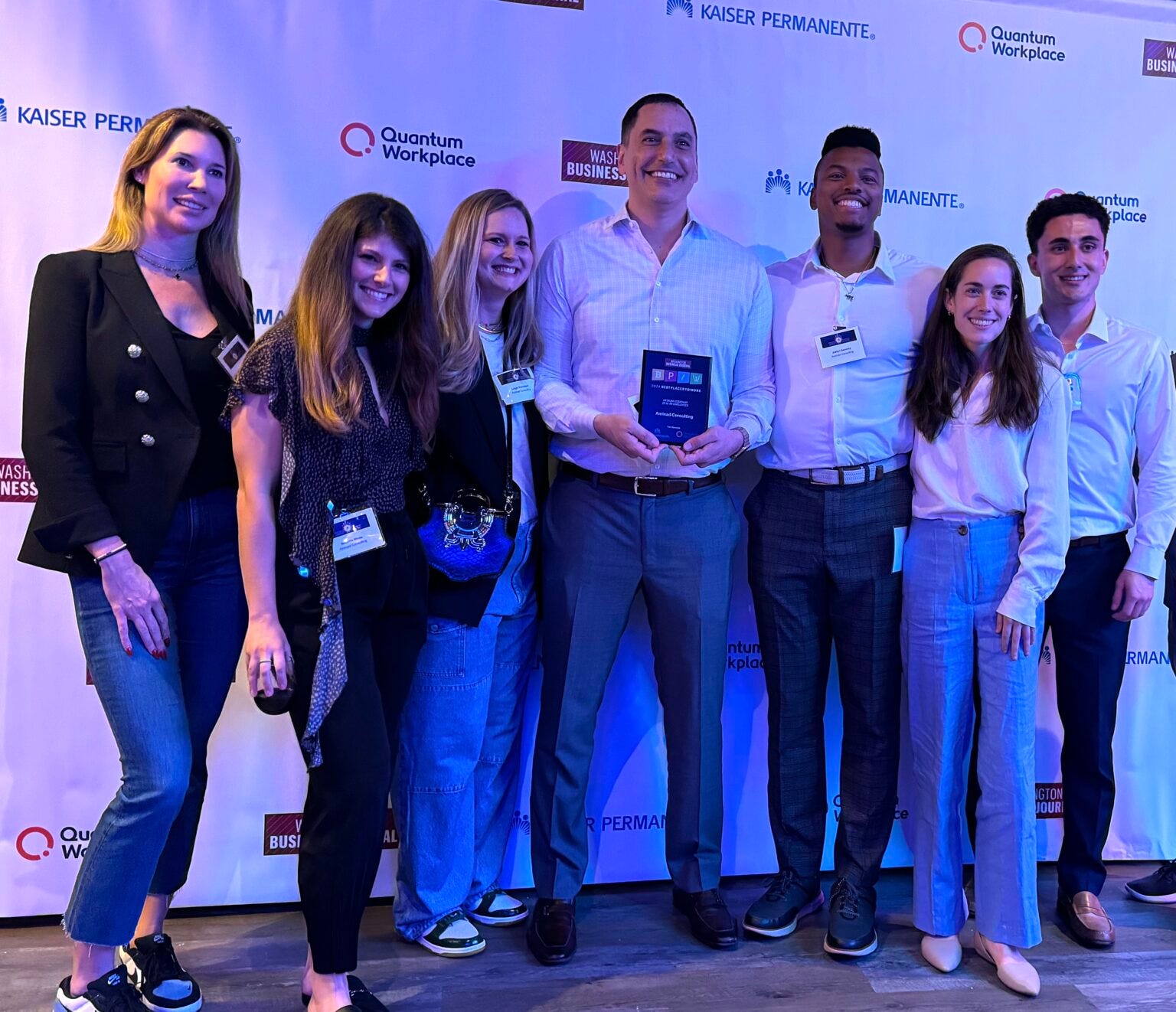
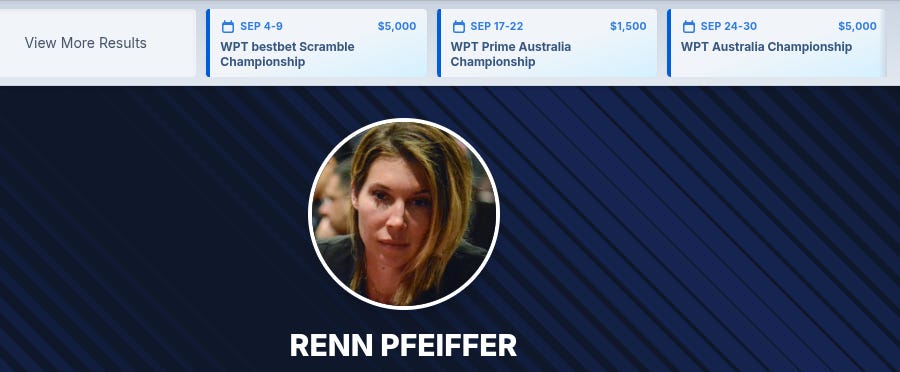
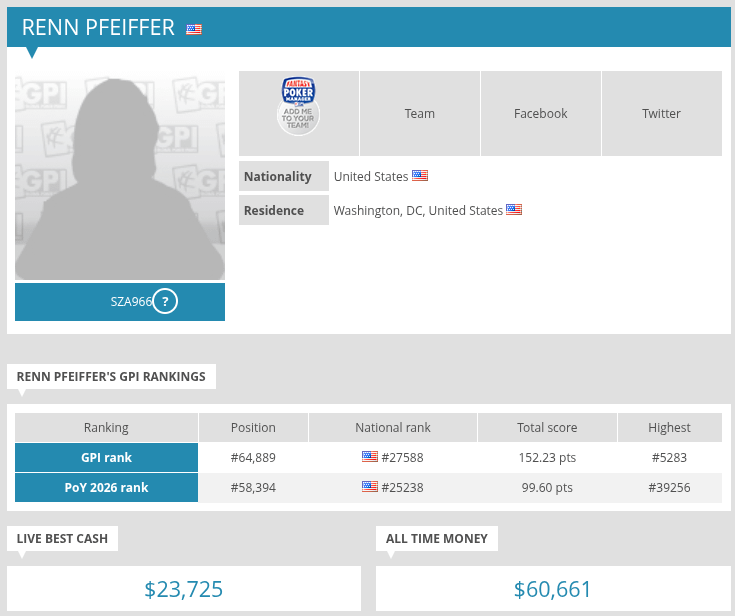
I didn't find Renn Pfeiffer from just one database search. PimEyes provided a lead, which I followed through public employer posts and professional records that consistently pointed to the same individual. Then, I discovered another source: poker records and video footage. This was significant because the video revealed a shoulder tattoo that facial recognition couldn't identify. When that tattoo matched the one in the other public materials, my identification no longer relied on a single tool or photograph.
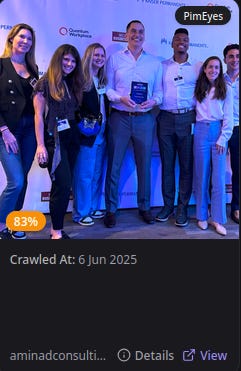

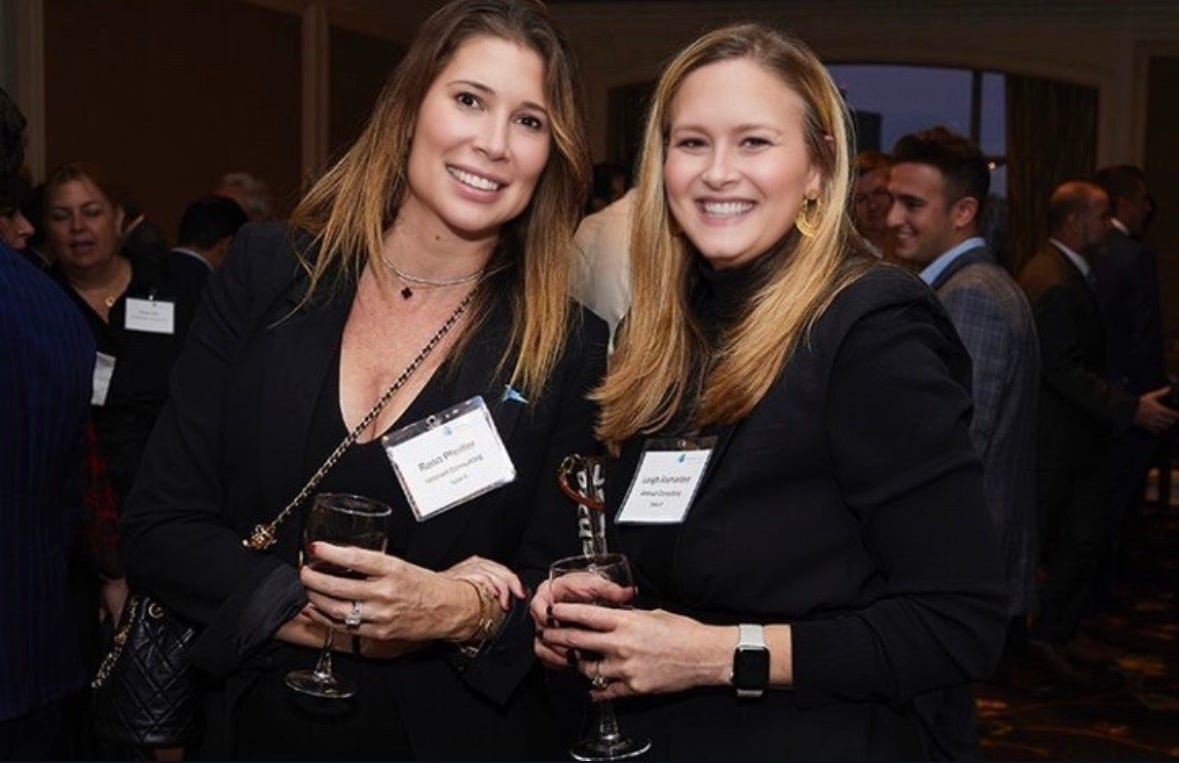
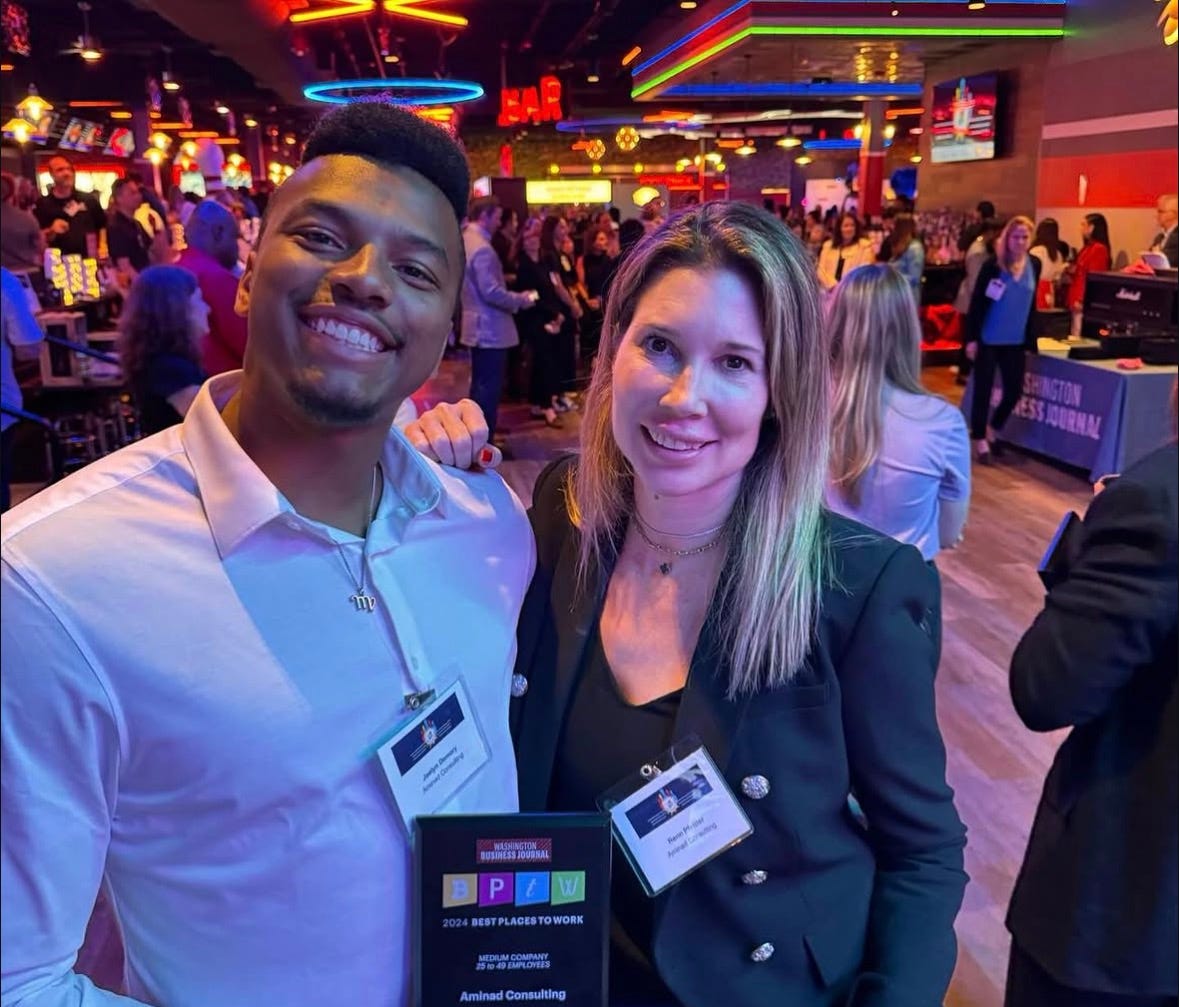
Renn Leah Files Pfeiffer the Poker Player.
Posts. Replies. Videos. Spaces. Screenshots. Dates. Then I compared the sequence with what the researchers describe. Start with denial. What did Pfeiffer dispute? What evidence did she offer? Sometimes she supplied useful information. Her CIA and NSA explanation is one example. It gave me a more precise description of her work. Other responses left the evidence behind and moved onto the person presenting it.
Freyd’s measurement work includes attacks portraying another person as a liar, crazy, delusional, manipulative or in need of help.
Pfeiffer’s response expanded far beyond my reporting. My character. Motives. Criminal history. Family. Employment. Methods. Supposed government ties.
Then comes reversal.
The person being scrutinized becomes the injured party. The person raising the issue becomes the threat.
Experimental work from Harsey and Freyd found that reversal changes how an audience sees both sides. The accused gains credibility. The accuser loses it.
Social media is almost built for the process.
A quote-post becomes a screenshot. A screenshot becomes a Space. A clip loses context. A background report appears. Another account repeats it. Then another. The argument drifts farther from the first evidence while the identities of the people involved get rewritten in public.
My reporting began with Pfeiffer’s identity, resume, professional claims, government work and methods. Within weeks the conversation centered on whether I was a criminal, stalker, doxxer, threat, fed, database abuser or some secret government-connected actor. So I went back through the record again.
Pfeiffer answered some questions. Her CIA and NSA explanation is one. She described working through consulting firms while spending substantial time supporting those agencies.
Fine. Put it in the record.
But when scrutiny of your professional claims turns into scrutiny of the reporter’s supposed criminal history, the criminal history needs to be right. Mine wasn’t. Even after speaking to me directly, admitting you ran a background check that found nothing, you did it again.
Accusations of doxxing based on a blurry photograph provided to an employer, which was subsequently published, require careful consideration of the information source.
Allegations of someone being a federal agent must be supported by substantive evidence. But this doesn’t seem to be an area of which Renn Leah Pfeiffer is too interested in.
When you ask whether something is “a literal psyop on the American people paid for by the government,” government funding, institutional ties, access and relationships have entered your own standard of proof.
Pfeiffer asks people to examine relationships.
I examined hers.
She asks people to look beyond resumes.
I looked beyond hers.
She treats government and intelligence proximity as meaningful.
I traced hers.
Employers. Family. Institutions. Money. Access.
All of it.
Her professional history runs through federal consulting, defense work and Intelligence Community clients. Her husband spent years in federal contracting. Her brother-in-law spent years near the top of Democratic presidential communications. Her uncle by marriage spent more than three decades inside American intelligence and later entered public fights involving Trump, Tulsi Gabbard and Turning Point USA. Those are not invented associations.
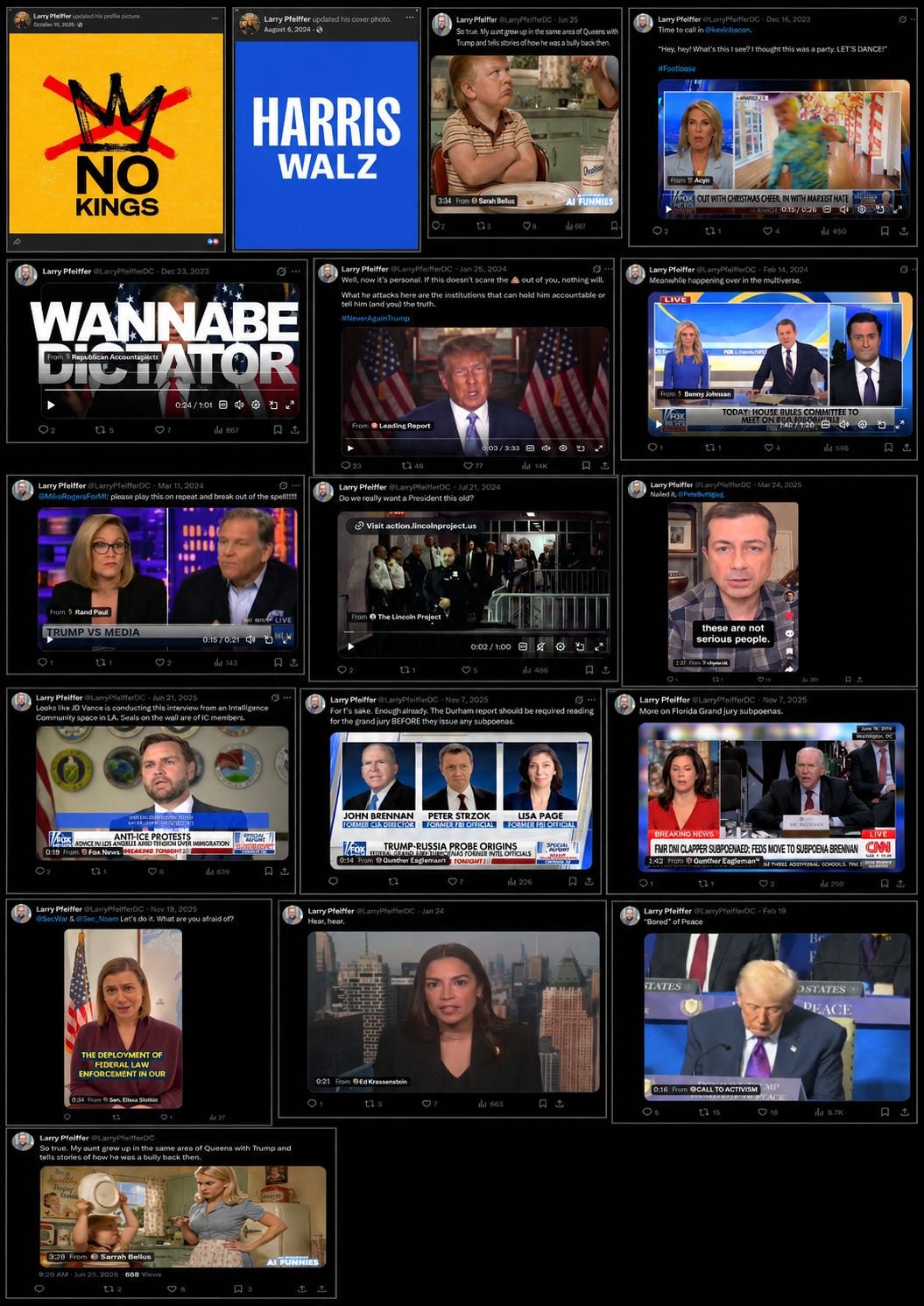
They are the same categories Pfeiffer uses when she examines other people.
Family. Access. Government work. Intelligence ties. Political influence. Institutional proximity.
So examine them.
Is The Leah Files independent of those relationships? Do they shape its target selection? Its politics? Its framing? Its sourcing? Its language? Does information ever move through those family relationships? Does political expertise? Intelligence expertise? Advice?
Those questions belong here because Pfeiffer built a reporting method where those questions belong everywhere else.
Does she distinguish between a contractor and an employee when describing another person’s government ties?
Does she distinguish between a public photograph and private doxxing?
Between a databroker lead and a verified court record?
Between government proximity and government direction?
Now widen the lens.
Pfeiffer built The Leah Files around scrutiny. Her tweets, TikToks and Substack posts ask audiences to examine government work, intelligence ties, family relationships, political access, funding, affiliations and institutional proximity.
She calls people feds.
She invokes psyops.
She questions motives through networks.
She asks readers to look past public biographies and examine who sits behind them.
Good.
Then her own work gets the same treatment.
Every tweet. Every TikTok. Every Substack post. Every person she labels. Every connection she draws. Every government tie she treats as suspicious. Every jump from proximity to motive. Every time CIA, NSA, intelligence or federal experience is used to establish authority. Every time somebody else gets less context than she expects for herself.
Put her work next to her own record.
Federal consulting. Intelligence Community clients. CIA and NSA work through private employers. A husband in federal contracting. A brother-in-law who spent years inside Democratic presidential communications. An uncle by marriage with decades inside American intelligence and a public record touching Trump, Gabbard and Turning Point USA.
Think about the people described as fed.
Take another look at The Leah Files. Think about where the term psyop comes from. Think about which relationships matter. How her personal connections might be driving the motives.
Notice who does not get that context.
Now, compare Pfeiffer’s standards to the reasons she gives for her career, her relationships, and her connection to power.
The Leah Files should be examined just as closely as Pfeiffer examines everyone else. It should not be a gentler version. It should not be a friendlier version either. It should be her version, but the truth.
She created the playbook.
She now has to read the manuscript.
The thing is people don’t go from 0-100 with this sort of dissembling. Some of what you’ve pieced together is still dependent on information that she was the source for. I very much doubt that prior to the past 18 months or so, Pfeiffer was completely honest about her work history and qualifications. People usually build up to this level of fabrication over the course of many years, usually starting in their teens or early adulthood.